


Infrastructure for Innovation:
How TRFK Supports AI & Beyond
What TRFK Does
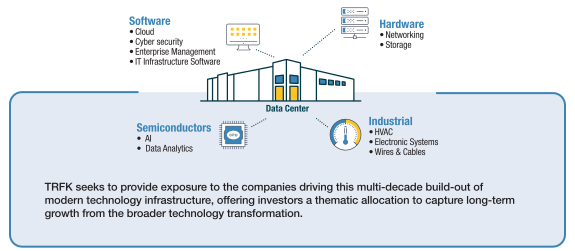
The ongoing digital revolution has transformed how people and organizations create, transmit, and utilize information. As global data volumes continue to expand rapidly, the infrastructure that enables this activity has become indispensable to the modern economy. At the heart of this infrastructure are data centers, an interconnected network of hardware, software, and industrial systems that enable digital services to function reliably and at scale. The Pacer Data and Digital Revolution ETF (TRFK) seeks to capitalize on this transformation by investing in companies whose businesses are fundamentally tied to the operation and enablement of data centers.
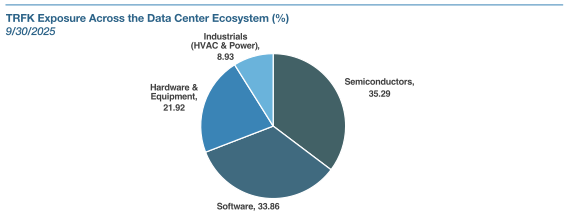
TRFK focuses on the entire data center ecosystem. This includes companies across four key areas:
- Semiconductors: provide computing power, which are core engines that make digital data processing possible. The chips support everything from general computation to specialized workloads in artificial intelligence (AI), cloud platforms, and network systems.
- Hardware & Equipment: enable storage, networking, and communication. For example, switches, routers, optical cables, and scalable storage solutions are essential for maintaining high-speed data transmission and efficient data retention within and across data centers.
- Software: platforms ensure data is usable, organized, and secure. Cloud software offers clients flexible ways to access computing resources on demand and deploy software applications. Data center management software helps administrators monitor, manage, and optimize data center resources and operations. Additionally, Cybersecurity software has become paramount in safeguarding sensitive data and maintaining the integrity of systems.
- Finally, to ensure uptime, equipment longevity, and reliable operation, HVAC (Heating, Ventilation, and Air Conditioning) and Power Systems are essential to maintaining high-density, high-performance computing environments.
While these companies span different industries, they share a common purpose: supporting the backbone of the digital world. Each contributes to the continuous flow of data—from creation to transmission, processing, storage, and delivery.
The key story is that data centers do not function because of one breakthrough technology or one dominant firm, but rather through a tightly integrated set of hardware, software, and operational systems working together. By investing across this ecosystem, TRFK offers exposure that is broader and more structurally aligned with the digital economy than strategies focused solely on mega-cap technology names.
Source: FactSet, Pacer Advisors
PAST PERFORMANCE IS NOT INDICATIVE OF FUTURE RESULTS. YOU CANNOT INVEST IN AN INDEX
TRFK’s approach captures a foundational and enduring theme: as society becomes increasingly digital, the demand for data center capacity (and the technologies that enable it) remains central to how the world connects, communicates, and innovates.
The AI Acceleration: Reinforcing the Importance of the Data Center Ecosystem
We are now entering the age of artificial intelligence. Training and deploying large AI models require enormous computational power, fueling demand for advanced semiconductors. Companies such as NVIDIA, AMD, Broadcom, ARM, and Intel form the core computing layer of the AI revolution. Their processors and accelerators power both high-performance model training and inference, supporting scaling across cloud, enterprise, and edge environments (computing closer to end users for lower latency).
However, AI requires more than just computing power. It demands high bandwidth data movement, secure data environments, reliable power and cooling. The rise of AI does not change the role of data centers—it magnifies it. The supporting ecosystem, including hardware suppliers, equipment manufacturers, and software enablers, creates a deep and diversified opportunity.
As AI models grow, high-speed networking becomes critical. Companies such as Arista Networks, Cisco Systems, Ciena, and Credo Technology provide switches, routers, and interconnect technologies that enable massive data movement, low-latency communication, and efficient connectivity between servers and data centers—essential for training, running, and scaling AI workloads.
Equally important is the software layer, responsible for managing, optimizing, and securing AI operations. Companies like Snowflake, Datadog, MongoDB, Palo Alto Networks, CrowdStrike, Okta, and Zscaler enable secure data access, intelligent analytics, real-time monitoring, and cybersecurity protection, ensuring AI systems remain efficient, reliable, and safe to operate.
In addition, AI data centers operate at higher power density and generate substantial heat. Therefore, advanced cooling and facility systems are critical. AAON, Trane Technologies, Johnson Controls, SPX Technologies, and nVent Electric supply cooling, airflow management, and power efficiency solutions that support performance stability of AI data centers.
Source: Statista, McKinsey & Company
PAST PERFORMANCE IS NOT INDICATIVE OF FUTURE RESULTS. YOU CANNOT INVEST IN AN INDEX
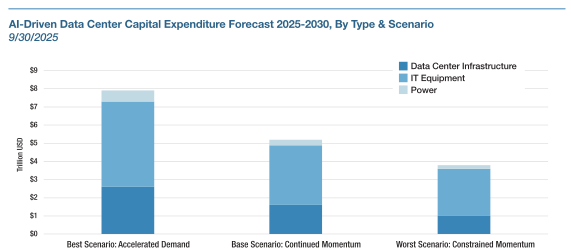
Many AI-themed strategies tend to focus on applications and consumer-facing platforms that use AI (more end-product and application-oriented). TRFK, by contrast, is built around the data-center backbone that enables AI. The companies in semiconductors, networking & storage, security & data management, and the physical facility systems are directly tied to data center CapEx cycles, reflecting the infrastructure expansion required to support AI scale-out. This makes TRFK a more structural, less trend-sensitive approach to participate in the AI growth story.
Beyond AI: The Build-Out of Modern Tech Infrastructure
While AI represents the most visible tech driver today, the broader transformation underway is about building the infrastructure of the intelligent economy.
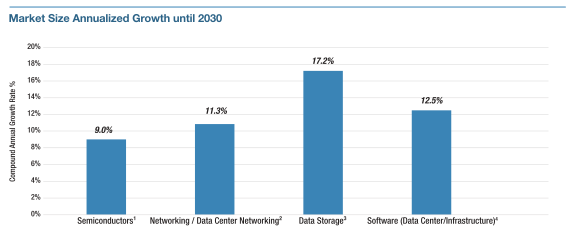
Semiconductors remain the cornerstone of technological progress. Future growth will be fueled by advances in computing performance, energy efficiency, and customization, enabling faster and more adaptive processing. Chipmakers are advancing next-generation architectures and specialized accelerators that power cloud, edge, and autonomous computing. As the industry transitions toward 2nm and beyond, advances in packaging and heterogeneous integration will further enhance computing density and efficiency.
The networking layer underpins the next generation of digital infrastructure, requiring ultra-fast, low-latency, energy-efficient connectivity. The shift to 800G and 1.6T Ethernet, fiber optics, and silicon photonics will unlock higher throughput for data centers and enterprise networks, while software-defined and automated architectures enable adaptive, intelligent traffic management across multi-cloud environments.
Data storage serves as the memory of the intelligent economy. Companies are investing in high-performance flash and hybrid solutions to efficiently manage massive and unstructured datasets. The next phase of development centers on AI-ready storage systems, NVMe (Non-Volatile Memory Express)-based architectures, and intelligent software that automates data tiering and management.
Finally, software forms the intelligence layer that connects data, infrastructure, and security. Companies are redefining enterprise platforms through cloud-native databases, analytics, and observability tools, while cyber security leaders deliver protection across increasingly distributed networks. Future growth will be anchored in AI-enabled software that enhances productivity, automates operations, and safeguards digital systems, making software the coordinating brain of the intelligent economy.
Source: Pacer Advisors
(1)Source: WFSB. https://www.infosys.com/iki/research/semiconductor-industry-outlook2025.html
(2)Source: WFSB. https://www.marketsandmarkets.com/Market-Reports/data-center-networking-market-1044.html
(3)Source: WFSB. https://www.fortunebusinessinsights.com/data-storage-market-102991
(4)Source: WFSB. https://dartpoints.com/blog/data-center-market/
PAST PERFORMANCE IS NOT INDICATIVE OF FUTURE RESULTS. YOU CANNOT INVEST IN AN INDEX
Together, these interconnected layers of semiconductors, networking, storage, and software form the foundation of the intelligent economy.

Download