


The PACER PERSPECTIVE
May 2024

| Tweet |
International Equity Investment Part 2:
Factor, Quality and Free Cash Flow
- Danke Wang, CFA, FRM, Portfolio Manager
When it comes to investing in international stocks, many investors default to the traditional asset allocation approach, in which broad-based index funds are chosen due to their cost-efficiency and diversification benefits. However, factor investing, an alternative strategy, offers the potential for even better results.
Key takeaways:
- Factor investing may offer an enhanced way for international equity investment.
- High quality international companies demonstrate consistency and stability over time.
- Screening for free cash flow may provide a compelling advantage for investors to capture opportunities in the global market.
Factor investing focuses on specific characteristics that influence the risk and return of individual securities or groups of securities. These factors, such as stock valuation, are believed to contribute to potentially higher returns and reduced risk over time. By incorporating these factors into their portfolios, investors can diversify their investments beyond traditional asset classes.
The concept of factor investing isn't new. It was introduced nearly three decades ago by Eugene F. Fama and Kenneth R. French when they expanded upon the Capital Asset Pricing Model (CAPM) with their factor model.
Over the years, their model has identified several factors, including value, size, profitability (quality), and momentum, that help explain stock market returns. Factor investing has been widely adopted among U.S. equity investors.
Factor Review
Similar to the U.S. market, various academic research suggests that factors like value, size, profitability (quality), and momentum have also demonstrated consistent premium in international markets over the long term.
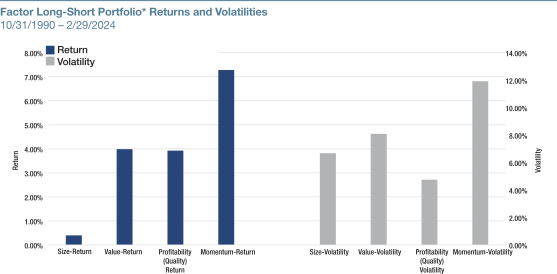
Using the framework established by Fama and French, we evaluate the performance of these factors among international developed stocks. Each factor is represented through a long-short portfolio. For instance, the size factor portfolio entails investing $1 in 1990 into a portfolio that is long a basket of small-cap stocks and short a basket of large-cap stocks.
As shown in the chart, all four factor portfolios have generated positive returns. This suggests that small size, value, quality, and momentum in international developed markets have historically outperformed their counterparts.
PAST PERFORMANCE IS NOT INDICATIVE OF FUTURE RESULTS. YOU CANNOT INVEST IN AN INDEX
Source: Pacer Advisors, Ken French data library (https://mba.tuck.dartmouth.edu/pages/faculty/ken.french/data_library.html) * Based on long-short portfolio data by Ken French: Size represented by SMB (small minus big). Value represented by HML (high book-to market minus low book-to-market). Quality represented by RMW (robust minus weak). Momentum represented by WML (winners minus losers).
Factor Batting Average, Factors vs their Counterparts*
10/31/1990 – 2/29/2024
| Size | Value | Profitability (Quality) | Momentum | ||
|---|---|---|---|---|---|
| 1 Year | % of Time Factors Have Outperformed | 56.0% | 66.6% | 78.4% | 79.9% |
| Average Outperformance | 5.8% | 10.7% | 5.7% | 13.0% | |
| Average Underperformance | -5.5% | -7.0% | -2.6% | -10.0% | |
| 3 Year | % of Time Factors Have Outperformed | 56.7% | 74.2% | 94.0% | 88.8% |
| Average Outperformance | 3.9% | 6.9% | 4.2% | 9.2% | |
| Average Underperformance | -2.8% | -4.1% | -0.5% | -4.1% | |
PAST PERFORMANCE IS NOT INDICATIVE OF FUTURE RESULTS. YOU CANNOT INVEST IN AN INDEX
Source: Pacer Advisors, Ken French data library (https://mba.tuck.dartmouth.edu/pages/faculty/ken.french/data_library.html) * Based on long-short portfolio data by Ken French: Size represented by SMB (small minus big). Value represented by HML (high book-tomarket minus low book-to-market). Quality represented by RMW (robust minus weak). Momentum represented by WML (winners minus losers).
Notably, the momentum factor stands out with the strongest performance in the international market, indicating that past winners tend to outperform past losers. However, it comes with the highest volatility, aka risk. Particularly, the higher average underperformance in both one-year and three-year periods indicates an increased risk of significant losses when the momentum trend reverses.
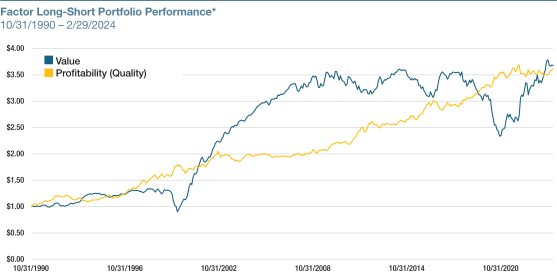
Value investing, which involves buying high book-to-market stocks and shorting their low book-to-market counterparts, has been historically rewarded. However, it is susceptible to periods of underperformance. The international value stocks experienced a significant rally until 2007, after which we observed more frequent instances of value underperforming growth.
The quality factor captures the return difference between firms with high operating profitability and their less profitable counterparts. Quality stands out as the single factor that has consistently delivered excess returns with the lowest volatility and the highest percentage of time in delivering excess returns on both one-year and three-year rolling basis.
PAST PERFORMANCE IS NOT INDICATIVE OF FUTURE RESULTS. YOU CANNOT INVEST IN AN INDEX
Source: Pacer Advisors, Ken French data library (https://mba.tuck.dartmouth.edu/pages/faculty/ken.french/data_library.html) * Based on long-short portfolio data by Ken French: Size represented by SMB (small minus big). Value represented by HML (high book-to market minus low book-to-market). Quality represented by RMW (robust minus weak). Momentum represented by WML (winners minus losers).
For investors with a long-term investment horizon, factor investing could potentially be a better approach to international equity markets.
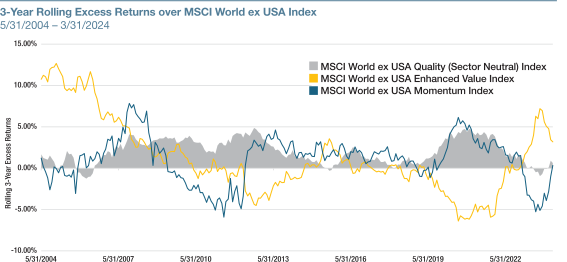
Expanding our view, a comparison of MSCI World ex USA factor indexes against the broad market index further underscores the outperformance of quality, value, and momentum factors over the past 23 years.
Particularly noteworthy is the performance of the quality factor, which outpaced the market 91% of the time in three-year rolling periods dating back to 2001. In contrast, while the value factor index achieved a similar performance, it surpassed the market's performance in only half of the historical time.
MSCI World ex USA Factor Index Performance
5/31/2001 – 3/31/2024
| MSCI World ex USA Quality (Sector Neutal) Index | MSCI World ex USA Enhanced Value Index | MSCI World ex USA Momentum Index | MSCI World ex USA Index | |
|---|---|---|---|---|
| Annualized Returns | 7.93% | 7.61% | 7.20% | 5.88% |
| Volatility (Montly Return) | 16.55% | 18.37% | 15.73% | 16.74% |
| % of 3-Year Rolling Periods Outperforming MSCI World ex USA | 91.21% | 54.81% | 70.71% | - |
PAST PERFORMANCE IS NOT INDICATIVE OF FUTURE RESULTS. YOU CANNOT INVEST IN AN INDEX
Source: Pacer Advisors, Bloomberg
PAST PERFORMANCE IS NOT INDICATIVE OF FUTURE RESULTS. YOU CANNOT INVEST IN AN INDEX
Source: Pacer Advisors, Bloomberg
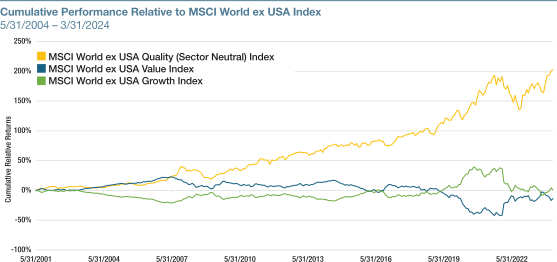
Among popular factor strategies, investing in high quality international companies has emerged as a robust and timetested approach.
MSCI Index Performance
5/31/2001 – 3/31/2024
| MSCI World ex USA Quality (Sector Neutral) Index | MSCI World ex USA Value Index | MSCI World ex USA Growth Index | MSCI World ex USA Index | |
|---|---|---|---|---|
| Annualized Return | 7.93% | 5.70% | 5.89% | 5.88% |
Source: Pacer Advisors, Bloomberg
PAST PERFORMANCE IS NOT INDICATIVE OF FUTURE RESULTS. YOU CANNOT INVEST IN AN INDEX
Source: Pacer Advisors, Bloomberg
Over the past 20 years, international quality stocks have not only outperformed the broad market but have also surpassed both growth and value styles, exhibiting resilience across different market environments. This is particularly significant given the challenge investors face in timing the market accurately. For example, based on the three-year rolling return analysis, MSCI World ex USA Quality (Sector Neutral) Index has demonstrated remarkable consistency. It has outperformed the growth index 100% of the time during periods when growth underperformed value, and 74% of the time in growth-oriented markets. Similarly, the quality index has also bested the value index, achieving success in 100% of the periods when value was out of favor, and in 42% of the periods when value was outperforming.
Getting International Quality through Free Cash Flow
“Quality” lacks a commonly accepted definition. MSCI characterizes quality as a blend of financial productivity, low leverage, and stability. Other practitioners incorporate additional attributes, such as earnings growth, low volatility, and accruals-related accounting quality. Research conducted by Jason Hsu1 suggests that characteristics related to profitability and investment tend to capture most of the quality return premium.
In our view, financial productivity is the most important metric, particularly free cash flow (FCF) production.
High free cash flow serves as a key indicator of a company's financial strength. Positive free cash flow signifies that a company is generating more cash than it requires for its operations, implying self-sufficiency and reduced reliance on external financing. While earnings-based metrics have traditionally been used to gauge profitability, accounting metrics such as GAAP (generally accepted accounting principles) earnings can be subject to management manipulation. This further emphasizes free cash flow’s implication on quality.
Pacer’s international strategies employ two FCF-centric metrics: Free Cash Flow Yield (FCF Yield) and Free Cash Flow Margin (FCF Margin). FCF yield, calculated as FCF relative to enterprise value, helps identify undervalued businesses with strong fundamentals and healthy balance sheets. FCF margin is measured as FCF compared against sales. FCF margin has emerged as a pivotal factor for identifying growth opportunities.
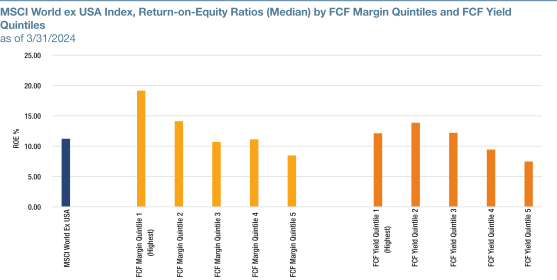
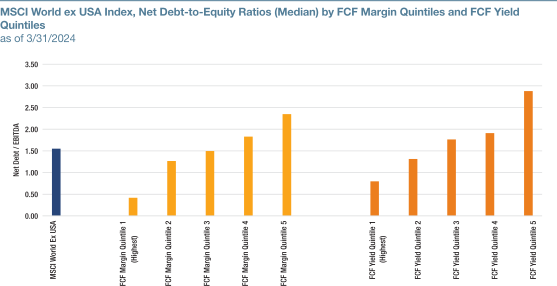
Both metrics exhibit distinct quality characteristics. For instance, the higher quintile FCF margin companies within the MSCI World ex USA Index demonstrate higher median return-on-equity (ROE) ratios, while the same trend is observed when the stock universe is broken down by FCF yield quintiles. When we measure leverage ratios among international stocks, both the highest FCF margin and FCF yield groups tend to have the lowest median net debt-to-equity ratios.
PAST PERFORMANCE IS NOT INDICATIVE OF FUTURE RESULTS. YOU CANNOT INVEST IN AN INDEX
Source: Pacer Advisors, FactSet
(1)https://www.tandfonline.com/doi/full/10.1080/0015198X.2019.1567194?src=recsys
PAST PERFORMANCE IS NOT INDICATIVE OF FUTURE RESULTS. YOU CANNOT INVEST IN AN INDEX
Source: Pacer Advisors, FactSet
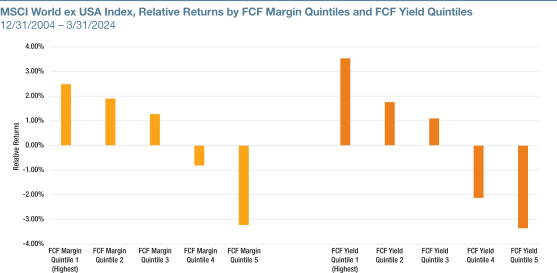
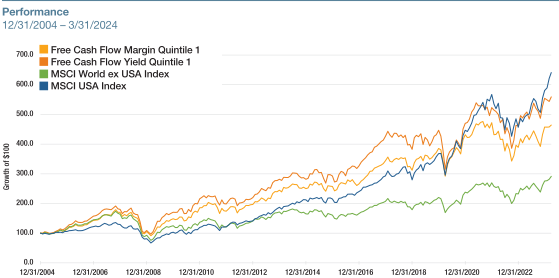
Regarding investment performance, the historical data strongly supports the notion that screening for FCF margin and FCF yield among international stocks has led to higher returns.
Over the past 20 years, the top quintile of FCF margin and FCF yield companies within the MSCI World ex USA Index have consistently outperformed the lower quintiles. Conversely, companies with the weakest FCF production, indicated by the lowest FCF margin and FCF yield, have consistently lagged behind the broader universe.
PAST PERFORMANCE IS NOT INDICATIVE OF FUTURE RESULTS. YOU CANNOT INVEST IN AN INDEX
Source: Pacer Advisors, FactSet
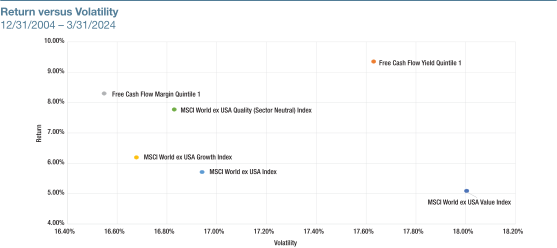
Moreover, the top FCF margin and FCF yield names have not only outperformed growth and value benchmarks but have also exhibited reduced volatility compared to their respective investment styles. Additionally, these top FCF margin and FCF yield stocks within the MSCI World ex USA Index have also surpassed the quality index over the same 20-year period.
PAST PERFORMANCE IS NOT INDICATIVE OF FUTURE RESULTS. YOU CANNOT INVEST IN AN INDEX
Source: Pacer Advisors, FactSet, Bloomberg
Free Cash Flow - Bridging the Gap
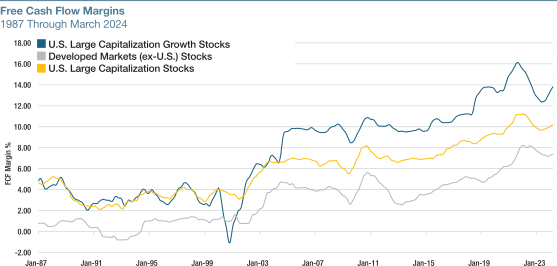
In the past few decades, one trend has emerged in the U.S. economy: there has been a notable increase in the amount of free cash flow generated by U.S. corporations. Since the year 2000, the ability to generate FCF has become a key feature for U.S. companies establishing a competitive edge.
The FCF advantage is one of the reasons that U.S. equities have been more attractive than the rest of the world when it comes to global asset allocation. This phenomenon likely contributes to the enduring outperformance of U.S. equities over the past 15 years.
PAST PERFORMANCE IS NOT INDICATIVE OF FUTURE RESULTS. YOU CANNOT INVEST IN AN INDEX
Source: Pacer Advisors, Empirical Research
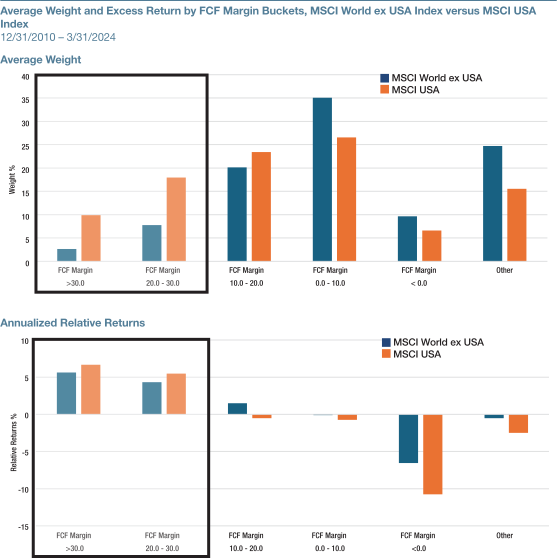
To illustrate the idea, we conducted a historical performance analysis of both MSCI World ex USA Index and MSCI USA Index, broken down by different FCF production groups (FCF margin buckets). Since 2010, on average, the international developed benchmark index has significantly underweighted the highest two FCF margin buckets relative to the U.S. However, these top two cohorts have delivered the most excess returns relative to the U.S. and international benchmark respectively.
PAST PERFORMANCE IS NOT INDICATIVE OF FUTURE RESULTS. YOU CANNOT INVEST IN AN INDEX
Source: Pacer Advisors, FactSet
The ability of U.S. corporations to generate substantial free cash flow has not only bolstered their financial resilience but has also enhanced their attractiveness to investors seeking reliable returns. As a result, U.S. equities have remained at the forefront of global investment preferences, underscoring the significance of free cash flow in shaping market dynamics and investment outcomes.
Prioritizing free cash flow production in international stock selection offers a compelling advantage. High FCF margin and high FCF yield international stocks not only outperformed U.S., and international equities, but may also bridge the gap between U.S. and international markets. Especially in years when international stocks underperformed U.S. counterparts, both the top quintile FCF margin and FCF yield international stocks have tended to outperform the MSCI World ex USA Index, while maintaining strong returns when international is ahead of the U.S.
PAST PERFORMANCE IS NOT INDICATIVE OF FUTURE RESULTS. YOU CANNOT INVEST IN AN INDEX
Source: Pacer Advisors, FactSet, Bloomberg
Average Calendar Year Returns
12/31/2004 – 3/31/2024
| FCF Margin Quintile 1 | FCF Yield Quintile 1 | MSCI World ex USA Index | |
|---|---|---|---|
| In Years International Outperforms U.S. | 17.72% | 21.63% | 16.64% |
| In Years International Underperforms U.S. | 5.55% | 5.48% | 1.85% |
PAST PERFORMANCE IS NOT INDICATIVE OF FUTURE RESULTS. YOU CANNOT INVEST IN AN INDEX
Source: Pacer Advisors, FactSet, Bloomberg
In conclusion, as investors navigate the complexities of global markets and seek to optimize their portfolios, factor investing stands out as an optimal solution with the potential for higher returns or reduced risks. Among the various factor-based strategies, screening for free cash flow may be a compelling avenue for enhancing international equity investments and achieving long term success.
The Pacer Developed Markets International Cash Cows 100 ETF (ICOW)
seeks to invest in high FCF yielding international stocks, providing investors with exposure to companies with robust cash flow generation and attractive valuations. Similarly,
The Pacer Developed Markets Cash Cows Growth Leaders ETF (EAFG)
targets stocks with high free cash flow margin in the MSCI EAFE Index, offering investors access to firms that exhibit strong financial profitability and growth potential. Both ETFs represent examples of how FCF-focused approaches can be implemented to capture investment opportunities among international equities and navigate the dynamic landscape of the global markets.
Long: A long—or a long position—refers to the purchase of an asset with the expectation it will increase in value.
Short: A short—or a short position—refers to the sale of an asset with the expectation it will decrease in value.
Long-Short Portfolio: A portfolio holding both long and short positions on securities. If dollar amounts in long and short positions are balanced, it approximately neutralizes the risk of the underlying market.
MSCI World ex USA Index: The index captures large and mid-cap representation across 22 Developed Markets countries (excluding the U.S.).
MSCI USA Index: The index is designed to measure the performance of the large and mid-cap segments of the U.S. market.
MSCI World ex USA Quality (Sector Neutral) Index: The index captures large and mid-cap representation across 22 Developed Markets countries (excluding the U.S.) exhibiting stronger quality characteristics relative to their peers within the same sector by identifying stocks with high quality scores based on three main fundamental variables: high Return-on-Equity (ROE), low leverage and low earnings variability.
MSCI World ex USA Enhanced Value Index: The index captures large and mid-cap representation across 22 Developed Markets countries excluding the U.S. exhibiting overall value style characteristics. The value investment style characteristics for index construction are defined using three variables: Price-to-Book Value, Price-to-Forward Earnings and Enterprise Value-to-Cash flow from Operations.
MSCI World ex USA Momentum Index: The index includes large and mid-cap stocks across 22 Developed Markets countries (excluding the U.S.). It is designed to reflect the performance of an equity momentum strategy by emphasizing stocks with high price momentum.
MSCI World ex USA Value Index: The index captures large and mid-cap securities exhibiting overall value style characteristics across 22 Developed Markets countries (excluding the U.S.). The value investment style characteristics for index construction are defined using three variables: book value to price, 12-month forward earnings to price and dividend yield.
MSCI World ex USA Growth Index: The index captures large and mid-cap securities exhibiting overall growth style characteristics across 22 Developed Markets countries (excluding the U.S.). The growth investment style characteristics for index construction are defined using five variables: long-term forward EPS growth rate, short-term forward EPS growth rate, current internal growth rate and long-term historical EPS growth trend and long-term historical sales per share growth trend.
GAAP (generally accepted accounting principles): A set of accounting rules, standards, and procedures issued and revised by the Financial Accounting Standards Board (FASB).
Return-on-Equity: Return-on-Equity is a financial ratio that measures the performance of a company based on its shareholders' equity outstanding, calculated by net income divided by its total shareholders' equity.
Net Debt-to-Equity: The net debt-to-equity ratio indicates how much debt (net of cash) a company has to finance its assets relative to the value of shareholders' equity.
Free Cash Flow (FCF): A company’s cash flow from operations minus capital expenditures (expenses, interest, taxes, and long-term investments)
Free Cash Flow Yield: FCF yield measures a company’s total free cash flow relative to its enterprise value. This is an internal statistic and does not constitute investor yield.
Free Cash Flow Margin: FCF margin is a profitability ratio that compares a company's free cash flow to its revenue to understand the proportion of revenue that becomes free cash flow (FCF).
This document does not take into account any investor’s particular investment objectives, strategies, tax status, or investment horizon. Please consult with your financial advisor and tax advisor before investing.
This document is not intended to be relied upon as a forecast, research or investment advice, and is not a recommendation, offer or solicitation to buy or sell any securities or to adopt any investment strategy. This document represents an assessment of the market environment at a specific time and is not intended to be a forecast of future events or a guarantee of future results. The user of this information assumes the entire risk of any use made of the information provided herein. There is no guarantee this strategy will be successful.
Download