


The PACER PERSPECTIVE
January 2025

| Tweet |
Is the market being hijacked by the
Magnificent Seven?
- Danke Wang, CFA, FRM, Portfolio Manager
The Dominance of the Magnificent Seven over 2 years The "Magnificent Seven" stocks—Alphabet, Amazon, Apple, Meta, Microsoft, Nvidia, and Tesla—have been a focal point for investors since early 2023. These seven companies delivered an extraordinary 76% performance (weighted average) for that year, with their collective weight rising to 25% in the Russell 1000 Index.
This concentrated influence has made them significant drivers of market performance, contributing 55% of the Russell 1000 Index's 2023 total return.
The dominance of the Magnificent Seven has raised concerns about narrow market breadth. Many U.S. equity investors worry that the index's high exposure to these stocks amplifies risk, particularly during periods of tech sector underperformance. In response, some investors have sought diversification by constructing portfolios that exclude these mega-cap names to mitigate concentration risks.
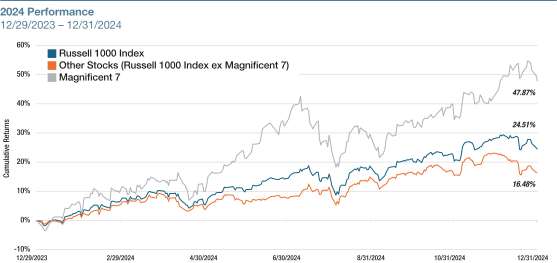
Despite speculation their momentum may fade, the Magnificent Seven continued to defy expectations in 2024, delivering another impressive 47% return. These companies contributed 48% of the Russell 1000 Index’s total return for the year, pushing their collective weight in the index to 30% by year-end. In comparison, the broader market as a whole (Russell 1000 Index) returned 24%, while the Russell 1000 Index ex-Magnificent Seven underperformed, lagging by 8%. Although this was an improvement from 2023 (the ex-Magnificent Seven index returned 15% compared to the Russell 1000 Index’s 26%), investors avoiding these mega-cap stocks faced substantial challenges.
FactSet, Pacer Advisors
PAST PERFORMANCE IS NOT INDICATIVE OF FUTURE RESULTS. YOU CANNOT INVEST IN AN INDEX
2024 Performance and Contribution
12/29/2023 - 12/31/2024
| Total Return | Contribution to Return | |
| Russell 1000 Index | 24.51% | |
| Magnificent Seven | 47.87% | 11.97% |
| Other Stocks | 16.48% | 12.55% |
Pacer Advisors, Bloomberg
PAST PERFORMANCE IS NOT INDICATIVE OF FUTURE RESULTS. YOU CANNOT INVEST IN AN INDEX
Challenges of a Concentrated Market
The continued outsized influence of the Magnificent Seven raises an important question: Is the market being “hijacked” by these influential stocks?
In today’s environment, market timing is difficult, and betting against the momentum of these mega-cap names remains highly speculative. As their dominance continues to reshape the investment landscape, navigating this concentrated market remains a critical challenge. Particularly for growth-oriented portfolio managers, owning the Magnificent Seven has become almost essential to keep pace with the market benchmark.
According to Morningstar data, the top 20 large-cap growth ETFs by assets delivered an average return of 32.89% in 2024, with significant exposure to the Magnificent Seven—averaging 54.83% by year-end.
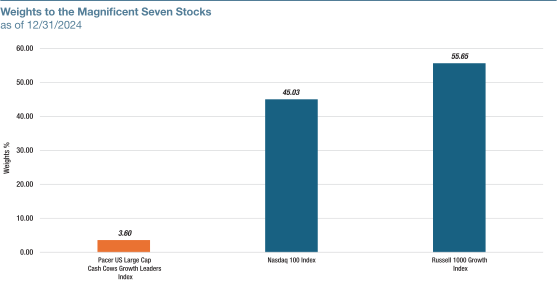
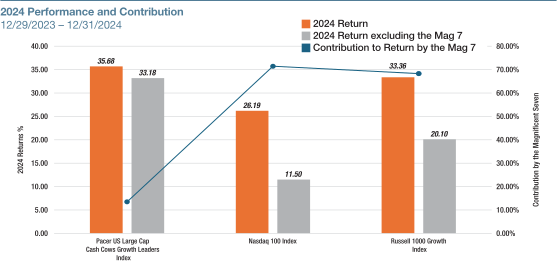
Similarly, the NASDAQ 100 and Russell 1000 Growth Index, serving as proxies for large-cap growth strategies, each held over 45% exposure to the Magnificent Seven at the end of 2024. These seven names contributed approximately 70% of the total return for the year.
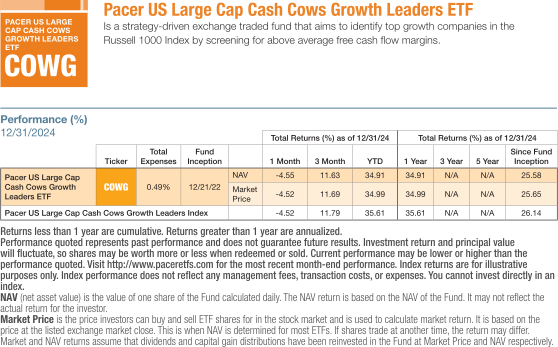
In contrast, the Pacer US Large Cap Cash Cows Growth Leaders Index (COWG Index) returned 35.68%, outperforming the growth benchmark while maintaining only an allocation averaging around 6.9% to the Magnificent Seven throughout the year. Those names accounted for just 13% of the index's 2024 performance, while the rest of the portfolio (excluding the seven) returned 33.18%, in line with the Russell 1000 Growth Index.
FactSet, Pacer Advisors
PAST PERFORMANCE IS NOT INDICATIVE OF FUTURE RESULTS. YOU CANNOT INVEST IN AN INDEX
FactSet, Pacer Advisors
PAST PERFORMANCE IS NOT INDICATIVE OF FUTURE RESULTS. YOU CANNOT INVEST IN AN INDEX
Despite a narrow market where it is almost inevitable to bow to top dominant stocks, COWG Index return in 2024 highlighted that strong performance can still be achieved through diversification and alternative strategies. High free cash flow margin (Free Cash Flow / Sales) stocks, in particular, offer a compelling solution.
Historical Perspective on Narrow Markets
Historically, there have been multiple episodes in which the market was top-heavy, while a small group of stocks dominated market gains. For example, during the late 1990s, several tech giants, including Cisco, Microsoft, and Intel, accounted for the majority of the market returns, while many other stocks lagged. At the peak, the top 10 stocks accounted for 25% of the weight in the Russell 1000 Index. Similarly, by the end of 2024, the top 10 holdings of the Russell 1000 Index represented over 30% of the large-cap benchmark, the highest level since the tech bubble.
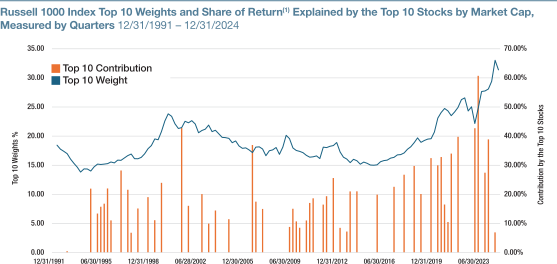
(1)Excluding quarters when the market return was lower than 5% or the return of the top 10 stocks was negative. FactSet, Pacer Advisors
PAST PERFORMANCE IS NOT INDICATIVE OF FUTURE RESULTS. YOU CANNOT INVEST IN AN INDEX
While narrow market environments amplify the influence of a few top-weighted names, they do not persist indefinitely. Over the long run, the performance gap between the market index as a whole and the index excluding the top 10 names tends to narrow. For example, the weighted average quarterly returns of the Russell 1000 Index have been 10.53%, similar to when the top 10 names are excluded.
Weighted Average Quarterly Returns (Annualized)
12/31/1991 - 12/31/2024
| All Time | Narrow Market | |
| Russell 1000 | 10.53% | 37.35% |
| Russell 1000 ex Top 10 | 10.53% | 28.43% |
Pacer Advisors, FactSet
PAST PERFORMANCE IS NOT INDICATIVE OF FUTURE RESULTS. YOU CANNOT INVEST IN AN INDEX
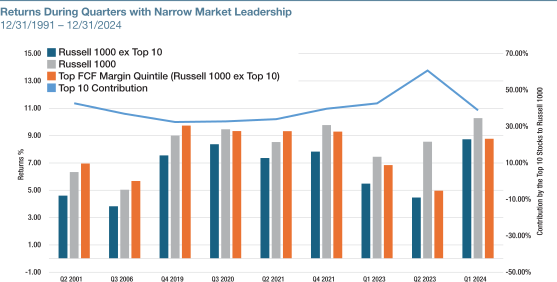
However, during narrow market periods—defined as quarters when the top 10 names contribute more than 30% to total market performance—the dynamics shift dramatically. In such environments, the Russell 1000 Index delivered strong weighted average returns of 37.35%, largely driven by its top 10 names. In stark contrast, the Russell 1000 excluding these top contributors returned only 28.43%, highlighting the heightened risks of overdependence on a small group of market leaders.
The Case for High Free Cash Flow (FCF) Margin Stocks
High FCF margin stocks have consistently demonstrated their resilience and ability to outperform, even when the top 10 names are excluded. Characterized by robust cash flow generation, these companies achieved long-term average returns of 12.56%, outperforming the broader Russell 1000 Index.
During narrow market periods, top quintile FCF margin stocks excluding the top 10 returned 35.37%. While slightly below the full Russell 1000 Index (37.35%), these stocks significantly outperformed the Russell 1000 Index excluding the top weighted names (28.43%).
Weighted Average Quarterly Returns (Annualized)
12/31/1991 - 12/31/2024
| All Time | Narrow Market | |
| Top FCF Margin Quintile (Russell 1000 ex Top 10) | 12.56% | 35.37% |
| Russell 1000 | 10.53% | 37.35% |
| Russell 1000 ex Top 10 | 10.53% | 28.43% |
Pacer Advisors, FactSet
PAST PERFORMANCE IS NOT INDICATIVE OF FUTURE RESULTS. YOU CANNOT INVEST IN AN INDEX
FactSet, Pacer Advisors
PAST PERFORMANCE IS NOT INDICATIVE OF FUTURE RESULTS. YOU CANNOT INVEST IN AN INDEX
In addition, when analyzing the quarterly performance during each narrow market period, we see that high FCF margin stocks (excluding the top 10) underperformed the broader market index by more than 1% in two quarters—Q2 2023 (3.58% lag) and Q1 2024 (1.51% lag). Outside of these instances, the high FCF margin cohort demonstrated resilience, keeping pace with or even outperforming the broader market.
Furthermore, selecting top FCF margin companies does not necessarily exclude top leading stocks in the market. For example, five of the Magnificent Seven companies boast high FCF margins, placing them in the top quintile FCF margin group. In another study, when the top 10 names in the Russell 1000 Index are included in the selection of high FCF margin companies, the results are even more compelling. The average (market cap weighted) quarterly performance of this expanded high FCF margin group significantly outpaces the broader market, delivering 52.48% compared to the 37.35% achieved by the Russell 1000 Index during narrow market periods.
Weighted Average Quarterly Returns (Annualized)
12/31/1991 - 12/31/2024
| All Time | Narrow Market | |
| Top FCF Margin Quintile (Russell 1000) | 12.51% | 52.48% |
| Top FCF Margin Quintile (Russell 1000 ex Top 10) | 12.56% | 35.37% |
| Russell 1000 | 10.53% | 37.35% |
| Russell 1000 ex Top 10 | 10.53% | 28.43% |
Pacer Advisors, FactSet
PAST PERFORMANCE IS NOT INDICATIVE OF FUTURE RESULTS. YOU CANNOT INVEST IN AN INDEX
The above data underscores the strength of high FCF margin stocks, especially in a market environment dominated by a small number of influential companies. Even without the inclusion of the dominant top 10 names, these fundamentally robust companies exhibit competitive performance.
In summary, while narrow market environments amplify the influence of a few top-weighted names, they also highlight the importance of diversifying into high-quality, fundamentally sound companies. For investors navigating the challenges of a top-heavy market, focusing on high FCF margin stocks not only mitigates the risks of overconcentration, but also provides a sustainable path to achieving strong, long-term performance. As market dynamics inevitably shift over time, adopting a disciplined strategy centered on cash-flow generation may be the key to staying ahead in both narrow and broad market environments.
Free Cash Flow (FCF): A company’s cash flow from operations minus capital expenditures (expenses, interest, taxes, and long-term investments).
Free Cash Flow Margin: the FCF margin is a ratio that compares a company's free cash flow to its sales to understand the proportion of revenue that becomes free cash flow (FCF).
Russell 1000 Index is a market-capitalization weighted index representing the top 1000 large-cap stocks in the Russell 3000 Index.
Russell 1000 Growth Index is a market capitalization weighted indexes 1000 large-and mid cap growth stocks in the Russell 3000 Index.
The NASDAQ-100® Index includes approximately 100 of the largest non-financial securities listed on The NASDAQ® Stock Market based on market capitalization. The NASDAQ-100® Index comprises securities of companies across major industry groups, including computer, biotechnology, healthcare, telecommunications, and transportation. However, it does not contain securities of financial companies, including investment companies. The NASDAQ-100® Index was developed by NASDAQ OMX®. The NASDAQ-100® Total Return Index is a total return version of the NASDAQ-100® and reflects the reinvestment of dividends paid by the securities in that Index.
P/E: price-to-earnings ratio is the ratio for valuing a company that measures its current share price relative to its earnings per share (EPS).
Download