


The PACER PERSPECTIVE
August 2025
Maximizing AI and Data Center Growth Potential with the TRFK ETF
– Robert Keller, CFA, CAIA, Portfolio Manager
Talking Points:
- Data Center Expansion Fuels AI Adoption: Massive investment in global data center infrastructure is driving the scalability, storage, and processing capacity required for accelerating AI deployment worldwide.
- Artificial Intelligence Transforms Digital Infrastructure: AI adoption is reshaping corporate strategy and capital allocation, positioning hyperscalers, semiconductor leaders, and cloud providers at the center of long-term technology growth.
- TRFK ETF Captures the AI and Data Center Revolution: TRFK provides diversified exposure to semiconductors, hardware, software, and industrial systems, with historically attractive risk-adjusted performance and efficient access to AI-driven digital infrastructure growth.
Introduction of the TRFK ETF and data focused investment philosophy
The global AI market is expanding rapidly, attracting substantial capital to established leaders and proven applications. TRFK’s targeted portfolio seeks to provide exposure to companies positioned to benefit from AI adoption and the broader digital revolution, aligning with key themes reshaping the global economy.
According to McKinsey & Company, depending on the growth scenario, global capital investment to support AI-related data center capacity could reach $3.7–$7.9 trillion by 2030, with the majority directed toward IT equipment, followed by infrastructure and power. Under an accelerated demand scenario, incremental AI capacity could reach 205 gigawatts, requiring $4.7 trillion in IT equipment alone.1
The Pacer Data and Digital Revolution ETF (TRFK) aims to capture opportunities arising from this accelerating technology boom. Its Artificial Intelligence–focused investment mandate incorporates both recent market developments and long-term structural trends in the Technology sector.
Data centers fuel and secure global AI adoption growth
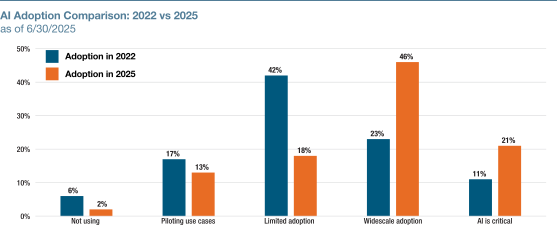
Worldwide AI adoption continues to gain momentum. According to a recent Statista report, 42% of organizations reported limited AI adoption in 2022; by 2025, over 46% are expected to achieve widescale implementation. Similarly, the share of organizations viewing AI as critical to operations is projected to rise from 11% in 2022 to 21% in 2025.2 This rapid expansion is driving demand for data storage and processing capacity, fueling growth in both data centers and cloud computing. Modern data centers increasingly deploy advanced hardware and robust infrastructure to support AI workloads. The reinforcement of data centers to support AI-driven innovation creates compelling opportunities for companies providing these relevant products and services
(1)McKinsey & Company. The Data Center Balance: How US States Can Navigate the Opportunities and Challenges. August 2025.
(2)https://www.statista.com/statistics/1346741/ai-adoption-rates-product-development/
Source: Statista. August 2025
PAST PERFORMANCE IS NOT INDICATIVE OF FUTURE RESULTS. YOU CANNOT INVEST IN AN INDEX
Important macroeconomic and quality factors in today’s market
Today’s technology leaders are fundamentally different from the speculative environment of the early 2000s, utilizing decades-developed business strategies that provide insulation in uncertain macroeconomic conditions. Many of the TRFK ETF key holdings benefit from strong free cash flow, high interest-coverage ratios, and sustainable earnings growth. While valuations of companies that can execute effectively on AI strategies may appear elevated, a disciplined focus on businesses whose valuations are supported by durable growth potential remains critical for capturing upside while mitigating risk.
Artificial Intelligence is no longer a subset of the digital revolution—it is the central force shaping the future of data processing, analytics, and enterprise efficiency. Hyperscalers such as Alphabet, Amazon, Meta, and Microsoft are committing billions in annual capital expenditures, with projected growth rates exceeding 40% and continued elevated investment through 2026. These companies remain free cash flow positive, giving investors confidence in the durability of the cycle. With hyperscale capex approaching $300 billion annually and AI semiconductor bookings near $200 billion, the scale of this transformation across industries rivals historic technological milestones.3
(3)Empirical Research Partners, The Hyperscalers: Making the Jump Hyperspace? August 11, 2025
AI positioned as the central driver of the TRFK ETF investment philosophy
TRFK’s strategic focus on AI-driven companies positions it to harness this unprecedented growth phase. We see four interconnected stages of adoption:
- Semiconductors – Advanced chips from leaders like NVIDIA provide the computational foundation for AI model development.
- Hardware – Reliable data transmission and communication equipment to optimize data delivery and enhance performance like Cisco’s Silicon One strategy.
- Infrastructure – Snowflake’s scalable cloud platform provides the capacity and reliability needed for enterprise AI deployment, reinforcing its role as a key enabler of cloud-based data solutions in modern data centers.
- Industrial - Complex HVAC systems maintain optimal conditions to protect IT infrastructure. SPX Technologies delivers dry and adiabatic cooling solutions for large-scale facilities, enhancing reliability and reducing operational risk.
Supported by robust fundamentals, favorable capital markets, and a resilient macro backdrop, we believe U.S. large-cap technology—particularly AI-focused hyperscalers, cloud providers, and semiconductor leaders—is well positioned to sustain market leadership and offers the potential for attractive long-term total returns.
Investing in the Data Center Ecosystem
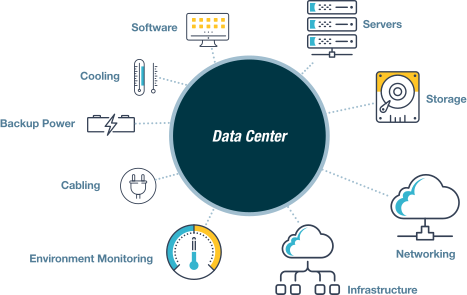
The rapid evolution of computing and communication has fueled a digital revolution, transforming data centers into a critical role as the backbone of how people and businesses operate.
These facilities depend on a diverse ecosystem—semiconductors, communication equipment, storage, software, and HVAC systems—to deliver essential digital services. Investing across this value chain offers diversified exposure to the digital economy, innovation, and long-term growth in data consumption.
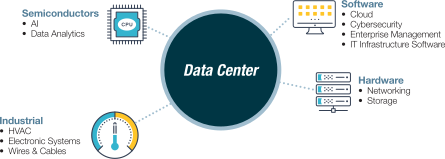
The TRFK ETF tracks the Pacer Data Transmission and Communication Revolution Index, targeting companies generating significant revenue from data use, processing, transmission, or storage, with a focus on data centers. This section explores the TRFK ETF four key investment areas and the opportunities they present.
Semiconductors:
Semiconductors are the foundation of modern electronics, enabling rapid data processing, connectivity, storage, and sensing. In data centers, semiconductors provide the capabilities essential for large-scale computing and AI workloads.
NVIDIA exemplifies the sector’s leadership, evolving from a GPU maker into a full-stack AI infrastructure and computing platform provider. Its new Blackwell architecture delivers real-time AI inference at data center scale, achieving $11 billion in quarterly sales and doubling year-over-year AI factory deployments. With other product developments similar to Blackwell, NVIDIA positions semiconductors at the core of next-generation AI and hybrid quantum-classical computing.4
(4)Nvidia Earnings Transcript June 11, 2025
Hardware: Communication and Storage
Communication Equipment: The digital revolution enables faster, more reliable data transmission and fuels global collaboration. Data center fabric, a specialized network of switches, routers, and fiber optics, optimizes communication for increasingly complex digital workloads.
Cisco’s Silicon One strategy, launched in 2019, delivers a programmable, flexible switching and routing architecture for service providers, enterprises, and hyperscalers. Now in 17 devices and expanding across its portfolio, Silicon One offers advantages over merchant silicon, including advanced packet buffering for AI traffic, enhanced telemetry, and cost efficiencies from in-house design. Paired with its NVIDIA partnership, Cisco is positioned to meet rising enterprise and edge AI infrastructure demand, with deployments expected to accelerate by late fiscal 2026.5
Data storage: Data storage is essential to manage the massive volume of digital data. Data centers optimize space and efficiency using varied solutions: hard disk drives for archival storage, solid-state drives for high-speed access, and storage arrays to centralize multiple devices. These systems offer different capacities, performance levels, and costs, enabling operators to tailor storage strategies to specific needs.
Western Digital is advancing high-capacity, cost-efficient HDD solutions to meet soaring demand for unstructured data storage driven by AI adoption. The company is transitioning to next-generation heat-assisted magnetic recording drives, working closely with hyperscale customers to qualify new technologies. Its platforms-based business model supports dense storage needs for infrastructure providers and neocloud firms.
Software: Cloud solutions, Specialized software, and Cybersecurity
Cloud solutions: In data centers, software integration is essential for delivering digital services. Cloud solutions provide on-demand access to computing resources and applications without heavy infrastructure investments. While “cloud” implies a virtual space, its physical foundation remains in data centers.
Snowflake positions itself as a central data management platform for enterprises. Investments in its products such as Openflow, Snowpark, and a partnership with dbt Labs strengthen its data processing and transformation capabilities. Strategic partnerships with cloud providers and integrators expand its ecosystem, reinforcing Snowflake’s role in powering cloud-based data solutions within modern data centers.6
Specialized software: Specialized software ensures data centers operate efficiently, maximizing uptime and minimizing downtime. Data center management platforms enable administrators to monitor, manage, and optimize infrastructure and resources. Datadog is a leader in cloud monitoring, delivering real-time visibility into software and infrastructure performance. Its broad capabilities—spanning infrastructure monitoring, log management, real-user monitoring, and security—support enterprises transitioning to cloud-native architectures. Datadog continues to invest in product innovation, global expansion, and strategic acquisitions, strengthening its leadership in data center and cloud monitoring.7
Cybersecurity: Cybersecurity is critical for protecting sensitive data and system integrity, especially in data centers that store vast amounts of information.
Fortinet addresses cybersecurity risks with its Unified SASE platform, integrating firewall, SD-WAN, and SASE into one OS—driving over 60% annual growth among large enterprises. Its AI-powered SecOps suite improves threat detection, automates security tasks, and safeguards AI infrastructure. Fortinet’s global network and integrated approach reduces complexity and costs.8
(5)Cisco Earnings Transcript July 11, 2025
(6)Snowflake, Inc. Investor Day Transcript, June 03, 2025
(7)Datadogs, Inc. Earnings Transcript, August 07, 2025
(8)Fortinet, Inc. Earnings Transcript, August 06, 2025
Industrial: Heating, Ventilation, and Air Conditioning
Data centers demand precise temperature, humidity, and air circulation control to ensure IT infrastructure reliability and minimize operational risk. Poor environments can lead to equipment damage or failure, making advanced HVAC systems essential.
SPX Technologies’ data center business has expanded significantly over the past year, positioning it as a potential major revenue driver. The company is targeting orders this year to generate 2026 revenue with the recent introduction of OlympusV Max, a dry and adiabatic cooling solution designed for large-scale facilities. Management believes its expertise in cooling towers, mechanical design, and CTI-validated performance provides a strong competitive advantage.9
The TRFK ETF provides diversified exposure to the digital economy by investing in four essential data center pillars—semiconductors, hardware, software, and industrial systems. By targeting companies at the core of the data consumption ecosystem, the TRFK ETF positions investors to benefit from the structural expansion of digital infrastructure and the ongoing transformation of global communication and computing.
Performance
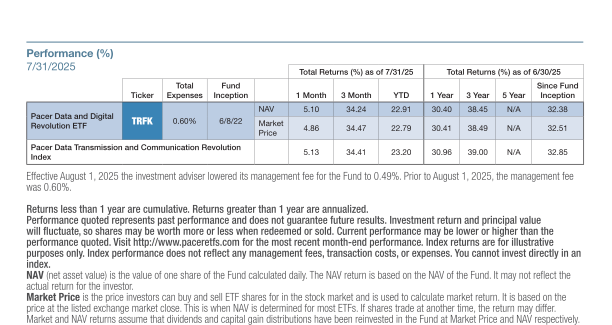
As of July 31, 2025, the TRFK ETF has delivered notable outperformance versus major equity benchmarks. Year-to-date, the TRFK ETF exceeded the S&P 500 Index by 14.3% and the technology-focused Nasdaq-100 Index by 12.0%. On a one-year basis, the fund outperformed the S&P 500 by 24.9% and the Nasdaq-100 by 20.4%.
(9)SPX Technologies, Inc. Earnings Call Transcript, July 31, 2025
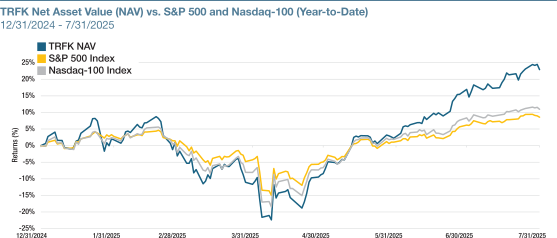
Source: Bloomberg. August 2025.
PAST PERFORMANCE IS NOT INDICATIVE OF FUTURE RESULTS. YOU CANNOT INVEST IN AN INDEX
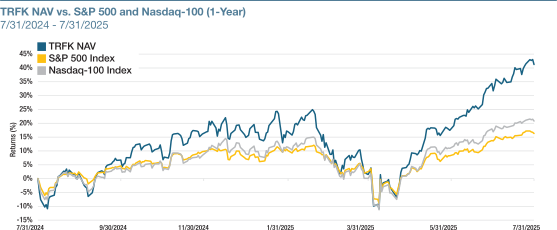
Source: Bloomberg. August 2025.
PAST PERFORMANCE IS NOT INDICATIVE OF FUTURE RESULTS. YOU CANNOT INVEST IN AN INDEX
From a factor exposure standpoint, the TRFK ETF maintained significantly higher allocations to high Beta and Momentum stocks compared to the S&P 500, while maintaining lower exposure to Value. Relative to the Nasdaq-100, the TRFK ETF exhibited higher exposure to Volatility and Momentum and lower exposure to Size.
Performance attribution shows that TRFK’s outperformance versus the S&P 500 and Nasdaq-100 was driven primarily by security selection. Over both the year-to-date and one-year periods, overweight positions in Oracle, Broadcom, MicroStrategy, Advanced Micro Devices, CrowdStrike, and NVIDIA were key positive contributors. The fund’s underweight to Apple, reflecting zero exposure, also added to relative performance. Conversely, underweight positions in Microsoft and Meta, along with an overweight to Palo Alto Networks, detracted from performance over both time horizons.
Importantly, the TRFK ETF not only surpassed the Nasdaq-100 in absolute returns, but also generated superior risk-adjusted performance. As of July 31, 2025, TRFK’s Sharpe ratio measured 1.2 versus 0.7 for the Nasdaq-100 on a one-year basis, and 1.1 versus 0.6 year-to-date. A Sharpe ratio compares a portfolio’s excess return (over a benchmark or risk-free rate) to the variability of those returns, with a higher Sharpe ratio indicating better risk-adjusted performance. This demonstrates the TRFK ETF ability to deliver higher returns per unit of risk taken, reinforcing its value proposition for investors seeking both performance and optimization in portfolio management risk allocation.
Overall, the TRFK ETF’s outperformance versus both the S&P 500 and Nasdaq-100, coupled with meaningfully higher Sharpe ratios, reinforces its recent outperformance for investors seeking both performance and efficiency.
The TRFK ETF offers investors a targeted, diversified approach to capturing the accelerating growth of AI and the digital revolution. By focusing on market leaders in semiconductors, infrastructure, cloud platforms, and critical data center technologies, the fund is positioned to benefit from the structural expansion of global digital infrastructure.
Strong fundamentals, disciplined security selection, and recent outperformance versus major benchmarks, underscore the TRFK ETF effectiveness as an investment vehicle in this rapidly evolving sector. As AI adoption continues to reshape industries and enhance productivity, the TRFK ETF offers exposure to companies that we believe are well positioned to benefit from these long-term structural trends, with the potential to generate attractive risk-adjusted returns.
Download