


The PACER PERSPECTIVE
August 2024

| Tweet |
Multi-Factor Investing:
Beyond the Traditional Factors
- Andrew Deegan, Portfolio Analyst and Danke Wang, CFA, FRM, Portfolio Manager
Many investors prefer a "plain vanilla" approach to portfolio construction, which typically involves broad market exposure with diversification across a wide range of companies. As a result, a significant portion of investment capital flows into broad-based index funds. For example, many of the largest ETFs by assets under management (AUM) track the S&P 500 Index or the Nasdaq 100 Index. SPY, IVV, VOO, and QQQ combined for $1.796 trillion in AUM as of the end June 2024.
Alternatively, investors may focus on a subset of the broad market. For instance, they can invest in securities within certain industries, sectors, or with specific characteristics to potentially achieve better investment outcomes. Factor investing, which has grown in popularity in recent years, is an example of this approach.
What Is Factor Investing?
Factors are characteristics that may help investors explain the differences in stock returns. Factor investing involves targeting securities with certain factor exposures in an attempt to generate long-term excess return over the broad equity market.
This concept stems from the Capital Asset Pricing Model (CAPM), a single factor model developed in the 1960s to explain investment returns. Market risk, expressed through beta, was the single factor included.
In the 1990s, Eugene Fama and Kenneth French expanded the CAPM into the Fama-French three-factor model by adding size and value factors alongside the market factor. Since then, more factors have been identified and recognized, such as momentum and profitability, which have become widely researched and adopted in the investment community.
Individual Factor Review
Academic research on different factors is done on a long-short basis.
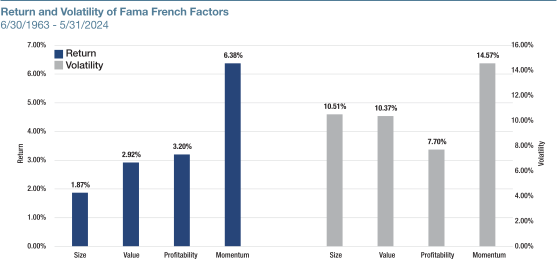
The size factor (SMB) is evaluated by the return spread between a basket of small-cap stocks and a basket of large-cap stocks. Positive performance from the size factor indicates small-cap stocks outperform large-cap stocks over time. Since 1963, the size factor has captured 208.86% cumulative returns, which translates to 1.87% annually.
The value factor (HML) is assessed by going long on high book-to-market stocks and short on low book-to-market stocks. Over time, the value factor has shown outperformance, achieving an annualized return of 2.92% from 1963 to 2024.
Profitability (RMW), often referred to as ‘quality’, is calculated by taking the return difference between companies with high operating profitability and those with low operating profitability. The profitability factor has demonstrated consistency in delivering long-term risk premium. Since 1963, this factor has captured a 3.20% annualized return.
The Momentum factor (WML), which exhibits high returns and volatility compared to other factors, is represented by the return of a portfolio buying “winners” and selling “losers”. "Winners" are stocks with upward-trending returns over the past 2-12 months, while "losers" are stocks with downward-trending returns. From 1963 - 2024 the momentum factor returned 6.38% annually.
While these factors have delivered positive premiums, they also come with different risk levels. Measuring the volatility of each factor portfolio, we observe that momentum has been the most volatile, while profitability has shown the lowest level of return fluctuation.
PAST PERFORMANCE IS NOT INDICATIVE OF FUTURE RESULTS. YOU CANNOT INVEST IN AN INDEX
Source: Pacer Advisors, Ken French Data Library (https://mba.tuck.dartmouth.edu/pages/faculty/ken.french/data_library.html) *Based on long-short portfolio data by Ken French: Size represented by SMB (small minus big). Value represented by HML (high book-to market minus low book-to-market). Profitability represented by RMW (robust minus weak). Momentum represented by WML (winners minus losers).
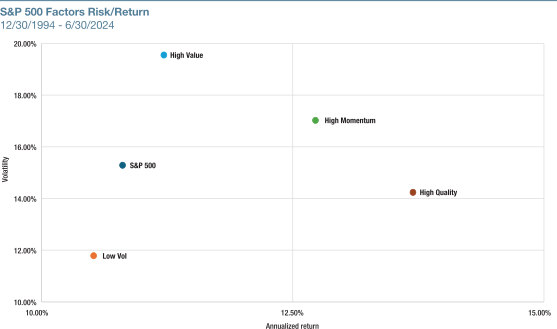
Over the past decade, factor investing has moved from academic theory to practical investment strategies. S&P has applied the concept of factor investing to broad-based indexes, such as the S&P 500 Index, to track performance of stocks with specific characteristics like High Value, High Quality, High Momentum, and Low Volatility (Low Vol).
Relative to the S&P 500 Index, all factors except Low Volatility outperform the market benchmark. Though Low Volatility has lagged in performance, historically it delivered better risk adjusted returns.
PAST PERFORMANCE IS NOT INDICATIVE OF FUTURE RESULTS. YOU CANNOT INVEST IN AN INDEX
Source: Pacer Advisors, Bloomberg *High Value represented by the S&P 500 Enhanced Value Index. High Momentum represented by the S&P 500 Momentum Index. High Quality represented by the S&P 500 Quality Index. Low Vol represented by the S&P 500 Low Volatility Index.
As each factor varies in their correlation with each other, investors may use different factors to diversify their portfolio. As shown below, High Momentum has a very low correlation with Low Volatility and High Value. This means, an investor with a portfolio bias towards high momentum stocks could potentially utilize Low Volatility or High Value investments to diversify the portfolio risk. The same narrative could be applied to the pair of the Low Volatility and High Quality factors.
Correlation
12/30/1994 – 6/30/2024
| S&P 500 Index | Low Vol | High Value | High Momentum | High Quality | |
| S&P 500 Index | 1.00 | 0.77 | 0.86 | 0.86 | 0.96 |
| Low Vol | 1.00 | 0.76 | 0.57 | 0.73 | |
| High Value | 1.00 | 0.63 | 0.88 | ||
| High Momentum | 1.00 | 0.79 | |||
| High Quality | 1.00 |
PAST PERFORMANCE IS NOT INDICATIVE OF FUTURE RESULTS. YOU CANNOT INVEST IN AN INDEX
Source: Pacer Advisors, Bloomberg *High Value represented by the S&P 500 Enhanced Value Index. High Momentum represented by the S&P 500 Momentum Index. High Quality represented by the S&P 500 Quality Index. Low Vol represented by the S&P 500 Low Volatility Index.
Is Factor Investing a Buy and Hold Strategy?
Although various factors have delivered premiums over long periods, their performance does experience ups and downs.
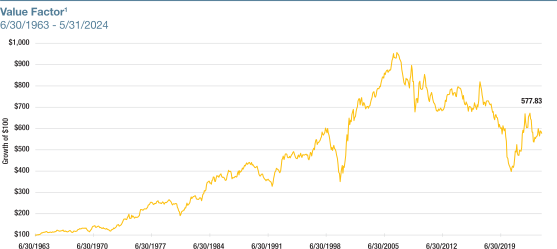
Fama French data shows that the value factor rallied for most of the history, despite having occasional periods of underperformance. However, since 2007, it has experienced significant underperformance, which triggered ongoing debates within the investment industry about whether value investing is no longer effective.
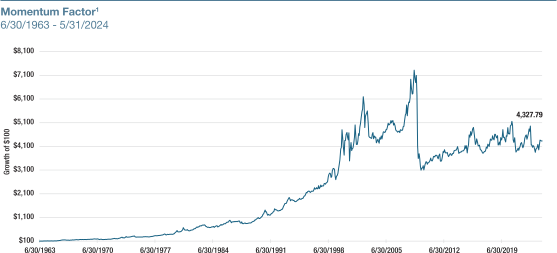
A similar pattern is observed with the momentum factor. After 2008, high momentum stocks experienced a sharp decline in share prices. Such a significant reversal of the price trend is the inherent risk faced by investors chasing after past winners.
PAST PERFORMANCE IS NOT INDICATIVE OF FUTURE RESULTS. YOU CANNOT INVEST IN AN INDEX
(1)Source(s): Pacer Advisors, Ken French Data Library (https://mba.tuck.dartmouth.edu/pages/faculty/ken.french/data_library.html) *Based on long-short portfolio data by Ken French: Size represented by SMB (small minus big). Value represented by HML (high book-to market minus low book-to-market). Profitability represented by RMW (robust minus weak). Momentum represented by WML (winners minus losers).
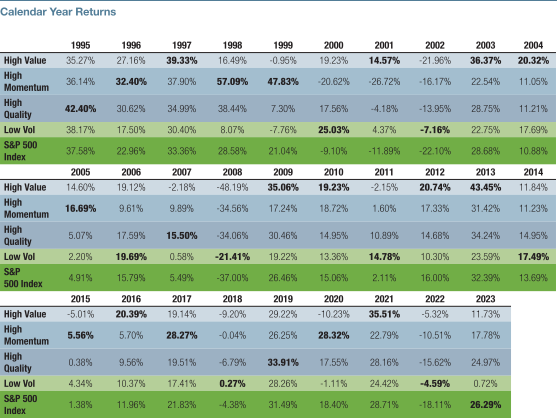
Furthermore, the historical performance analysis on S&P factor indexes reveals that not all factors will always yield similar returns in the same time frame. For instance, in different years we have seen factors underperform or outperform each other relative to the broad market.
The below table shows the calendar year returns of each factor along with the S&P 500 Index benchmark dating back to 1995.
Notably, for the years of 1998 and 1999, the High Momentum factor achieved the best performance among the factors listed, outperforming the S&P 500 Index by more than 25% consecutively. The Low Volatility factor, however, was the worst ranked factor in those same years, delivering single digit and negative returns. In 2000, as the market dynamic shifted dramatically, the High Momentum factor demonstrated the worst performance, down by over 20%. On the flip side, Low Volatility scored the best performance, up 25.03%, while the S&P 500 Index was down 9.10%.
PAST PERFORMANCE IS NOT INDICATIVE OF FUTURE RESULTS. YOU CANNOT INVEST IN AN INDEX
Source: Pacer Advisors, Bloomberg * High Value represented by the S&P 500 Enhanced Value Index. High Momentum represented by the S&P 500 Momentum Index. High Quality represented by the S&P 500 Quality Index. Low Vol represented by the S&P 500 Low Volatility Index.
Thus, a buy-and-hold strategy may not be the most favorable approach for long-term factor investing, as this approach is less responsive to the cyclical nature of the factors’ performance. Instead, a factor rotation strategy may allow investors to dynamically adjust their investments, focusing on factors with higher potential for outperformance.
What about the other side of the factor?
Within the investment community, much of the focus is only on one side of the factors, such as, High Value (cheaper valuations), High Momentum (stocks with recent outperformance), High Quality (companies with high profitability), and Low Volatility (stocks with less price volatility).
Such is well justified.
First, it is practical to invest in companies with high operating profitability and a strong balance sheet, as these companies are more likely to create value for shareholders. Conversely, low quality companies are perceived as higher risk, with a greater chance of financial instability or even failure over the long term.
Secondly, from an investment return perspective, the traditional factors like High Value, High Momentum, High Quality, and Low Volatility generally outperform their nontraditional counterparts, such as Low Value, Low Momentum, Low Quality, and High Volatility.
However, the nontraditional factors do experience periods of high returns. From 1994 to 2024, these nontraditional factors outperformed the traditional factors between 43% and 54% of all quarters, with the average outperformance ranging from 2.5% to 9.6%.
Factor Performance
12/30/1994 – 6/30/2024
| High Vol vs Low Vol | Low Value vs High Vale | Low Momentum vs High Momentum | Low Quality vs High Quality | |
| % of Quarters Nontraditional Side Outperformed | 54.70% | 49.57% | 43.29% | 50.43% |
| Avg Outperformance of Nontraditional Side | 9.64% | 6.08% | 7.59% | 2.54% |
| Avge Underperformance of Nontraditional Side | -9.45% | -5.95% | -7.24% | -4.44% |
PAST PERFORMANCE IS NOT INDICATIVE OF FUTURE RESULTS. YOU CANNOT INVEST IN AN INDEX
Source: Pacer Advisors, Bloomberg *High Value represented by the S&P 500 Enhanced Value Index. Low Value Represented by the S&P 500 Enhanced Value - Lowest Quintile Index. High Momentum represented by the S&P 500 Momentum Index. Low Momentum represented by the S&P 500 Momentum - Lowest Quintile Index. High Quality represented by the S&P 500 Quality Index. Low Quality represented by the S&P 500 Quality - Lowest Quintile Index. Low Vol represented by the S&P 500 Low Volatility Index. High Vol represented by the S&P 500 Volatility - Highest Quintile Index.
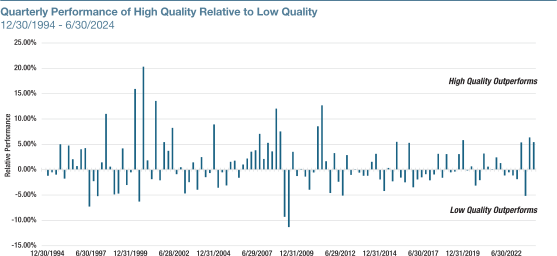
Below we take a closer look at the quarterly relative performance between the S&P 500 High and Low Quality Indexes. Interestingly, low quality companies outperform high quality companies 50.43% of the time.
Even if we extend the relative performance period to an annual basis, we still have seen examples of Low Quality being more favorable. In 2012 and 2017, Low Quality beat High Quality by over 9%.
PAST PERFORMANCE IS NOT INDICATIVE OF FUTURE RESULTS. YOU CANNOT INVEST IN AN INDEX
Source: Pacer Advisors, Bloomberg * High Quality represented by the S&P 500 Quality Index. Low Quality represented by the S&P 500 Quality - Lowest Quintile Index.
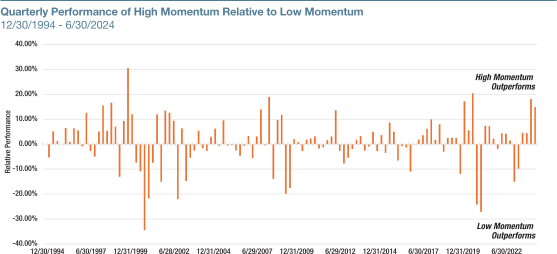
From 1994 to 2024, Low Momentum stocks have outperformed High Momentum stocks in 43.59% of quarters. Particularly, there are numerous examples in which Low Momentum outperforms High Momentum by over 20% in a calendar year (2000, 2001, 2009, 2016).
PAST PERFORMANCE IS NOT INDICATIVE OF FUTURE RESULTS. YOU CANNOT INVEST IN AN INDEX
Source: Pacer Advisors, Bloomberg *High Momentum represented by the S&P 500 Momentum Index. Low Momentum represented by the S&P 500 Momentum - Lowest Quintile Index.
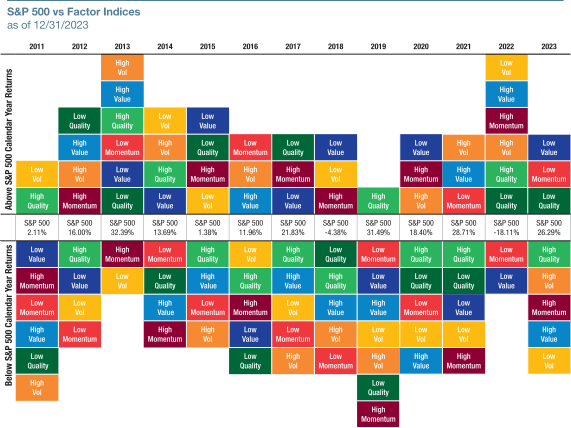
Considering both traditional and nontraditional sides of each factor broadens the range of opportunities that an investor can take advantage of. The table below illustrates the year-by-year performance of an 8-factor mix (including both traditional and nontraditional factors), compared to the S&P 500 Index dating back to 2011.
We see all factors rotate regarding market leadership. Although different years are associated with different scenarios, we have observed up to six and as few as one factor achieve higher returns than the S&P 500 Index each year.
PAST PERFORMANCE IS NOT INDICATIVE OF FUTURE RESULTS. YOU CANNOT INVEST IN AN INDEX
Source: Pacer Advisors, Bloomberg * High Value represented by the S&P 500 Enhanced Value Index. Low Value Represented by the S&P 500 Enhanced Value - Lowest Quintile Index. High Momentum represented by the S&P 500 Momentum Index. Low Momentum represented by the S&P 500 Momentum - Lowest Quintile Index. High Quality represented by the S&P 500 Quality Index. Low Quality represented by the S&P 500 Quality - Lowest Quintile Index. Low Vol represented by the S&P 500 Low Volatility Index. High Vol represented by the S&P 500 Volatility - Highest Quintile Index.
Therefore, integrating these factors into a rotation strategy may help investors achieve a better long-term excess return relative to the broad market.
Our Take on Factor Investing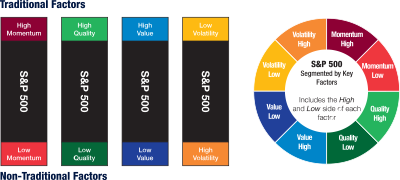
In light of the aforementioned themes, Pacer ETFs has partnered with Lunt Capital to introduce a factor rotation ETF series for both large-cap and mid-cap stocks. Pacer Lunt Large-Cap Multi-Factor Alternator ETF (PALC) tracks the Lunt Capital U.S. Large-Cap Multi-Factor Rotation Index (PALC Index) and Pacer Lunt Mid-Cap Multi-Factor Alternator ETF (PAMC) tracks the Lunt Capital U.S. Mid-Cap Multi-Factor Rotation Index (PAMC Index).
Both indices rotate monthly among the High and Low sides of Volatility, Momentum, Value, and Quality based on a proprietary methodology that evaluates the risk-adjusted relative strength of each factor. Each month, two factors are selected.
Below illustrates the factor exposure of the PALC Index year to date. In 2024 as of 6/28/2024, the index exposure has been focused on High Momentum, High Value, and High Quality, among which High Momentum and High Quality are the top performing factors within the S&P 500 Index
2024 Lunt Capital U.S. Large-Cap Multi-Factor Rotation Index (PALC Index) Exposure
PAST PERFORMANCE IS NOT INDICATIVE OF FUTURE RESULTS. YOU CANNOT INVEST IN AN INDEX
Source: Pacer Advisors.
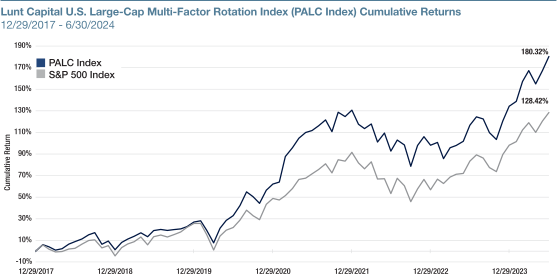
As a result, the PALC Index has performed 19.65% year to date, relative to 15.29% from the S&P 500 Index. Since its launch in 2017, the PALC Index has outpaced the S&P 500 Index, returning 17.18% compared to 13.55% on an annualized basis.
PAST PERFORMANCE IS NOT INDICATIVE OF FUTURE RESULTS. YOU CANNOT INVEST IN AN INDEX
Source: Pacer Advisors, Bloomberg
In 2024, the PAMC Index has been exposed to High Momentum, Low Volatility, and High Quality.
2024 Lunt Capital U.S. Mid-Cap Multi-Factor Rotation Index (PAMC Index) Exposure
PAST PERFORMANCE IS NOT INDICATIVE OF FUTURE RESULTS. YOU CANNOT INVEST IN AN INDEX
Source: Pacer Advisors.
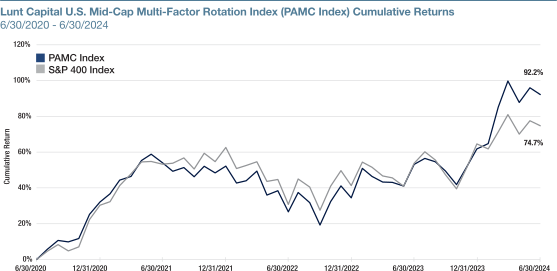
The PAMC Index has outpaced the S&P 400 Index by 12.5% year to date driven by the strong performance of High Momentum and High Quality factors in the mid-cap segment.
Since inception in 2020, the PAMC Index has returned 17.75% annually, compared to 14.98% from the S&P 400 Index.
PAST PERFORMANCE IS NOT INDICATIVE OF FUTURE RESULTS. YOU CANNOT INVEST IN AN INDEX
Source: Pacer Advisors, Bloomberg
As factor investing has gained popularity, a dynamic multi-factor approach could aid investors in the ever-changing market environment. PALC and PAMC offer such tools to potentially enhance portfolio diversification and yield excess returns over the broad market.
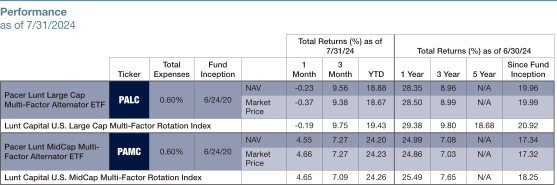
Returns less than 1 year are cumulative. Returns greater than 1 year are annualized. Performance quoted represents past performance and does not guarantee future results. Investment return and principal value will fluctuate, so shares may be worth more or less when redeemed or sold. Current performance may be lower or higher than the performance quoted. Visit http://www.paceretfs.com for the most recent month-end performance. Index returns are for illustrative purposes only. Index performance does not reflect any management fees, transaction costs, or expenses. You cannot invest directly in an index.
NAV (net asset value) is the value of one share of the Fund calculated daily. The NAV return is based on the NAV of the Fund. It may not reflect the actual return for the investor.
Market Price is the price investors can buy and sell ETF shares for in the stock market and is used to calculate market return. It is based on the price at the listed exchange market close. This is when NAV is determined for most ETFs. If shares trade at another time, the return may differ. Market and NAV returns assume that dividends and capital gain distributions have been reinvested in the Fund at Market Price and NAV respectively.
Long: A long—or a long position—refers to the purchase of an asset with the expectation it will increase in value.
Short: A short—or a short position—refers to the sale of an asset with the expectation it will decrease in value.
Long-Short Portfolio: A portfolio holding both long and short positions on securities. If dollar amounts in long and short positions are balanced, it approximately neutralizes the risk of the underlying market.
Volatility: the degree of variation of a trading price over time, usually measured by the standard deviation of price returns.
Correlation: a statistical measure of the strength of a linear relationship between two variables.
Beta: a statistic that measures the expected increase or decrease of an individual stock price in proportion to movements of the benchmark.
Book-to-market: The ratio of book value to market value of equity. A high ratio is often interpreted as a value stock (the market is valuing equity relatively cheaply compared to book value).
Operational profitability: operating income before depreciation and amortization minus interest expense scaled by book equity.
Small-cap: A stock from a public company whose total market value, or market capitalization, is about $300 million to $2 billion. The precise figures vary.
Mid-Cap: A company with a market capitalization value between $2 billion and $10 billion. The precise figures vary.
Large-cap: A company with a market capitalization value of more than $10 billion. The precise figures vary.
S&P 500 Index: The index includes 500 leading companies in the U.S. and covers approximately 80% of available market capitalization.
S&P 400 Index: Standard and Poor's Midcap 400 Index is a capitalization-weighted index which measures the performance of the mid-range sector of the U.S. stock market.
SPDR S&P 500 ETF Trust (SPY): is an exchange-traded fund incorporated in the USA. The ETF tracks the S&P 500 Index.
iShares Core S&P 500 ETF (IVV): is an exchange-traded fund incorporated in the USA. The ETF tracks the performance of the S&P 500 Index.
Vanguard S&P 500 ETF (VOO): is an exchange-traded fund incorporated in the USA. The ETF tracks the performance of the S&P 500 Index.
Invesco QQQ Trust Series 1 (QQQ): is an exchange-traded fund incorporated in the USA. The ETF tracks the Nasdaq 100 Index includes 100 of the largest non-financial companies by market cap listed on Nasdaq.
S&P 500 Enhanced Value Index: S&P Enhanced Value indices provide exposure to 20% of the stocks in the eligible universe that have the top value scores as measured by the following factors: Price/Book, Price/Sales, Price/Earnings.
S&P 500 Enhanced Value – Lowest Quintile Index: The S&P 500® Enhanced Value – Lowest Quintile Index is designed to measure the performance of the 100 lowest-ranked stocks in the S&P 500 based on value score. Value scores are calculated using three fundamental measures: book value-to-price, earnings-to-price, and sales-to-price.
S&P 500 Momentum Index: The S&P 500® Momentum Index is designed to measure the performance of securities in the S&P 500 universe that exhibit persistence in their relative performance.
S&P 500 Momentum – Lowest Quintile Index: The S&P 500® Momentum – Lowest Quintile Index is designed to measure the performance of securities in the S&P 500 that exhibit the lowest persistence in their relative performance.
S&P 500 Quality Index: The S&P 500® Quality Index is designed to track high quality stocks in the S&P 500 by quality score, which is calculated based on return on equity, accruals ratio and financial leverage ratio.
S&P 500 Quality - Lowest Quintile Index: The S&P 500® Quality - Lowest Quintile Index is designed to measure the performance of the 100 lowest-ranked stocks in the S&P 500 based on quality score.
S&P 500 Low Volatility Index: The S&P 500 Low Volatility Index is designed to measure the performance of the 100 least volatile stocks of the S&P 500 Index.
S&P 500 Volatility - Highest Quintile Index: The S&P 500® Volatility – Highest Quintile Index is designed to measure performance of the 100 most-volatile stocks in the S&P 500.
This document does not take into account any investor’s particular investment objectives, strategies, tax status, or investment horizon. Please consult with your financial advisor and tax advisor before investing. This document is not intended to be relied upon as a forecast, research or investment advice, and is not a recommendation, offer or solicitation to buy or sell any securities or to adopt any investment strategy. This document represents an assessment of the market environment at a specific time and is not intended to be a forecast of future events or a guarantee of future results. The user of this information assumes the entire risk of any use made of the information provided herein. There is no guarantee this strategy will be successful.
Download