


The PACER PERSPECTIVE
February 2025

| Tweet |
Optimizing Corporate Bond Investments
Through a Free Cash Flow Lens
- Danke Wang, CFA, FRM, Portfolio Manager
Corporate bond ETFs have surged in popularity among investors seeking diversified exposure to fixed-income markets over the past two decades. These funds typically hold anywhere from 1,000 to 5,000 bonds, offering broad-based exposure that mirrors the overall corporate bond universe.
However, this "one-size-fits-all" approach results in portfolios that track the broader corporate bond market, essentially providing little differentiation beyond basic characteristics like maturity (short, medium, or long-term), duration, or environmental, social, and governance (“ESG”) considerations.
In recent years, U.S. corporate bond ETF listings have increased significantly, yet the largest funds in the sector have maintained their dominant share of Assets Under Management (“AUM”). Despite strong demand, there has been a low supply of innovative corporate bond ETF solutions launched in the U.S. marketplace.
|
Review of Corporate Bond ETFs |
|
|
Corporate bond ETFs have become increasingly popular among investors seeking diversified exposure to the fixed-income market. These funds often hold thousands of bonds, ensuring broad security diversification. However, this broad portfolio construction results in minimal differentiation between funds, highlighting the limited variety of strategies available to investors in this space. The U.S. investment-grade corporate bond ETF market is heavily concentrated, with a few dominant players controlling most assets. The largest, Vanguard Intermediate-Term Corporate Bond ETF (VCIT), holds $48.7 billion in AUM (as of 12/31/2024), accounting for 35.9% of the market's AUM. Together, the top three funds – VCIT, iShares iBoxx $ Inv Grade Corporate Bond ETF (LQD), and iShares 5-10 Yr Investment Grade Corporate Bond ETF (IGIB) – comprise 68.2% of the market, while the ten largest funds collectively represent 94.6% of total AUM.1 Despite their large scale, these funds exhibit strikingly similar portfolios, each investing in 1,495 to 5,474 bonds without adopting distinct investment strategies. In some cases, the similarities are particularly pronounced, such as between VCIT and Schwab 5-10 Year Corporate Bond ETF (SCHI), which both track the same index. (1)Bloomberg, Morningstar |
Although the funds offer individual bond diversification, this advantage is often undercut by poor industry diversification. For instance, the financial and industrial sectors make up an average of 34.2% and 22.9% of the ten funds, with some single-sector weights exceeding 50%. The differences among the ten funds are limited to a few key factors: Apart from the above differences, those top ETFs and their underlying indices lack meaningful differentiation, highlighting the homogenous nature of the U.S. investment-grade corporate bond ETF market |
The factor which provides the most meaningful differentiation within the corporate bond ETF sector is credit quality. Almost all U.S. corporate bond ETFs fall into either the high credit rating (Investment Grade) or low credit rating (High Yield) category. This dynamic reflects a strong trend among investors: credit ratings serve as the cornerstone in investors’ decision making for evaluating the creditworthiness of companies. Investors seeking lower-risk corporate bond opportunities tend to rely heavily on investment-grade ratings supplied by Fitch, Moody’s, and S&P. However, a more nuanced and data-driven approach that emphasizes Free Cash Flow (FCF) metrics may refine the investment process by identifying companies with strong credit profiles and financial health.
Free cash flow (“FCF”) represents the cash generated by a company after accounting for capital expenditures (CapEx) required to maintain and expand its business. It is a vital indicator of financial stability, as it reflects a company's ability to service debt, reinvest in growth, or return value to shareholders through dividends or buybacks.
Strong FCF metrics, such as high FCF margin (FCF/Sales, the proportion of revenue converted into free cash flow) and FCF yield (FCF/EV, free cash flow relative to enterprise value), are closely linked to higher credit quality. Companies with robust FCF metrics often exhibit financial discipline, operational efficiency, and strong profitability, which are key attributes that underpin creditworthiness and reduce investment risk.
To explore the relationship between FCF and credit quality, we group the Russell 1000 Index companies into quintiles based on their FCF margin and FCF yield and then compare the top quintile companies for each metric to the overall index universe.
By including companies with long term issuer credit ratings, we found that over ten years, 77.11% of companies in the top quintile of FCF margin held investment-grade ratings. This is significantly higher than the broader Russell 1000 Index, where 71.72% of companies are investment-grade. Such indicates that FCF margin is a valuable metric for identifying a more concentrated pool of creditworthy firms. On the other hand, 71.05% of top FCF yield companies are investment-grade, closely aligning with the Russell 1000 average.
Average Share of Companies by Credit Quality
12/31/2010 - 12/31/2024
| Top Quintile FCF Margin Companies in Russell 1000 Index | Top Quintile FCF Yield Companies in Russell 1000 Index | Russell 1000 Index | |
| Shares of Investment Grade Companies | 77.11% | 71.05% | 71.72% |
| Shares of Below Investment Grade Companies | 22.89% | 28.95% | 28.28% |
Source: FactSet, Bloomberg, Pacer Advisors
PAST PERFORMANCE IS NOT INDICATIVE OF FUTURE RESULTS. YOU CANNOT INVEST IN AN INDEX
A deeper analysis of various financial metrics further reveals that top FCF margin and FCF yield companies exhibit higher credit quality across profitability, leverage, and liquidity, compared against the broader universe and even investment-grade companies within the Russell 1000 Index.
Profitability
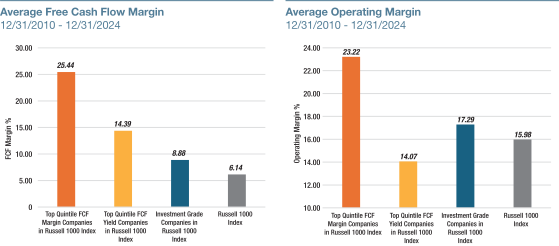
Profitability is a fundamental measure of a company’s ability to generate earnings relative to revenue, assets, or shareholders’ equity, and it serves as a critical indicator of its capacity to meet debt obligations. Key metrics include operating margin, FCF margin, return on equity (“ROE”), and return on assets (“ROA”).
Companies in the top quintile of FCF margin stand out with significantly stronger cash flow generation than investment-grade firms and the broader market. Their operating margins are also well above average, showcasing superior cost management and profitability. While companies in the top FCF yield group maintain slightly lower operating margins, their FCF margin still outpaces the broader index, reinforcing their financial strength.
Source: FactSet, Pacer Advisors
PAST PERFORMANCE IS NOT INDICATIVE OF FUTURE RESULTS. YOU CANNOT INVEST IN AN INDEX
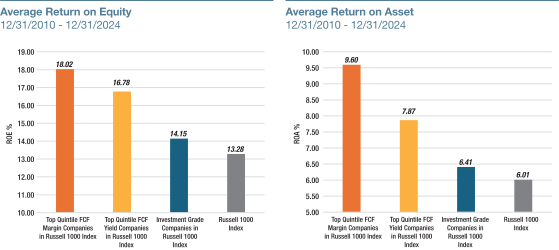
Return metrics (ROE and ROA) further highlight these companies’ efficiency in use of capital to generate shareholder value. As shown in the following charts, both the top FCF margin and leading FCF yield companies deliver higher returns on equity (ROE) and assets (ROA) than the average investment-grade companies.
Source: FactSet, Pacer Advisors
PAST PERFORMANCE IS NOT INDICATIVE OF FUTURE RESULTS. YOU CANNOT INVEST IN AN INDEX
Leverage
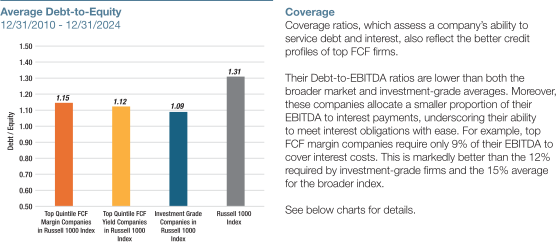
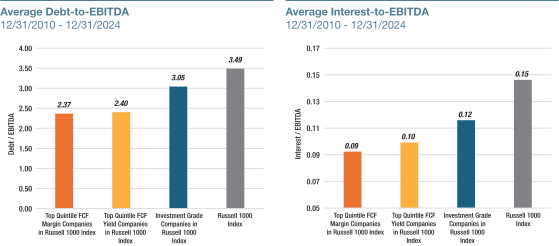
Leverage metrics provide evidence of the companies' financial discipline. The Debt-to-Equity ratios of top FCF margin and top FCF yield companies are notably lower than the broad market average and only slightly above the investment-grade level. Such observation aligns with the view that robust FCF production allows companies to effectively self-finance their operations, reducing reliance on external funding and enhancing financial stability.
Source: FactSet, Pacer Advisors
PAST PERFORMANCE IS NOT INDICATIVE OF FUTURE RESULTS. YOU CANNOT INVEST IN AN INDEX
Source: FactSet, Pacer Advisors
PAST PERFORMANCE IS NOT INDICATIVE OF FUTURE RESULTS. YOU CANNOT INVEST IN AN INDEX
Liquidity metrics measure a company’s ability to manage short-term liabilities. Strong free cash flow generation supports higher liquidity ratios, positioning firms well to handle immediate financial needs.
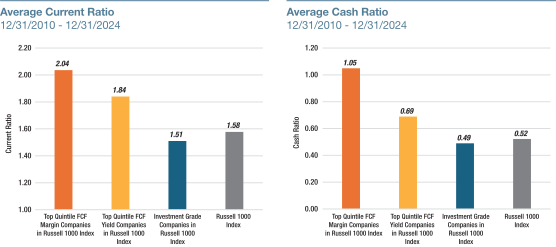
The current ratio compares a company’s current assets to current liabilities, evaluating a business’s ability to pay off its short-term liabilities with its short-term assets. Companies with high FCF metrics, particularly the ones in the top FCF margin group, boast current ratios significantly higher than both investment-grade firms and the broader market.
Source: FactSet, Bloomberg, Pacer Advisors
PAST PERFORMANCE IS NOT INDICATIVE OF FUTURE RESULTS. YOU CANNOT INVEST IN AN INDEX
Similarly, the cash ratio (measures cash and cash equivalents relative to short term liability), a more conservative measure of liquidity, shows that these companies maintain substantially higher cash reserves relative to short-term debt. This exceptional liquidity underscores their strong financial flexibility to meet near-term financial obligations.
The above observations of different angles emphasize the value of incorporating FCF metrics into the credit-related investment process. While credit ratings remain a valuable tool for assessing creditworthiness, the inclusion of FCF metrics adds a layer of precision and insight. By focusing on FCF margin and FCF yield, investors can identify companies with strong financial foundations, which may not be fully reflected in traditional credit ratings.
With all of this in mind, the Pacer US Cash Cows Bond Index (MILK Index) strategy integrates the FCF perspective into a corporate bond investment framework, offering a more comprehensive assessment of a company’s financial health and debt-paying ability.
The MILK Index aims to include corporate bonds issued by companies from Pacer US Cash Cows 100 Index (high FCF yield) and/or the Pacer US Large Cap Cash Cows Growth Leaders Index (high FCF Margin). By leveraging FCF metrics, the strategy refines the investment universe and enhances investors’ ability to identify high-quality bonds, ultimately improving risk management and long-term return potential.

The financial instrument is not sponsored, promoted, sold or supported in any other manner by Solactive AG nor does Solactive AG offer any express or implicit guarantee or assurance either with regard to the results of using the Index and/or Index trade mark or the Index Price at any time or in any other respect. The Index is calculated and published by Solactive AG. Solactive AG uses its best efforts to ensure that the Index is calculated correctly. Irrespective of its obligations towards the Issuer, Solactive AG has no obligation to point out errors in the Index to third parties including but not limited to investors and/or financial intermediaries of the financial instrument. Neither publication of the Index by Solactive AG nor the licensing of the Index or Index trade mark for the purpose of use in connection with the financial instrument constitutes a recommendation by Solactive AG to invest capital in said financial instrument nor does it in any way represent an assurance or opinion of Solactive AG with regard to any investment in this financial instrument.
Free Cash Flow Margin: measures a company's total free cash flow relative to its sales.
Operating Margin: measures a company's operating income relative to its sales.
Return on Equity: calculated by dividing net income by shareholders' equity.
Return on Asset: calculated by dividing net income by the company’s asset.
Debt-to-Equity: calculates the value of total debt and financial liabilities against the total shareholder's equity.
Debt-to-EBITDA: measures the value of total debt and financial liabilities against the EBITDA (earnings before interest, taxes, depreciation and amortization).
Interest-to-EBITDA: measures a company's EBITDA against its interest burden
Current Ratio: compares a company's current assets to its current liabilities and short-term debt obligations.
Cash Ratio: compares a company's cash and equivalents to its current liabilities and short-term debt obligations.
The Solactive Pacer US Cash Cows Bond Index was released on 12/13/24.
Vident Advisory, LLC d/b/a Vident Asset Management (“VA” or the “Sub-Adviser”) serves as investment sub-adviser to the Fund.
Download