


The PACER PERSPECTIVE
April 2026

Revisiting International Equity in 2026
In 2024, the case for international equities was largely theoretical. Since 2025, it has become increasingly observable.
Two years ago, Pacer ETFs published a piece outlining several factors that could support international equities after an extended period of U.S. market dominance. At the time, the case for international stocks was largely based on structural considerations, including attractive relative valuations, lower market concentration, and potential currency dynamics.
Since then—particularly since 2025—global markets have begun to show early signs of shifting leadership. After more than a decade of sustained U.S. outperformance, international equities demonstrated renewed strength, prompting investors to reassess the opportunities across global markets.
Index Total Returns for Calendar Year 2025
While it seems too early to conclude that a sustained rotation is underway, many of the underlying drivers identified earlier remain firmly in place and may continue to provide support for international equities going forward.
Source: Pacer Advisors, Bloomberg
| 2025 Total Returns | |
|---|---|
| MSCI EAFE | 31.89% |
| MSCI ACWI ex USA | 33.11% |
| MSCI USA | 17.75% |
| S&P 500 | 17.88% |
Cycles of Leadership
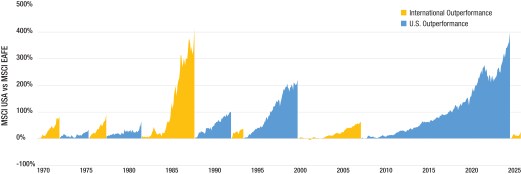
Over the past several decades, leadership between U.S. and international equities has tended to move in cycles. Historically, periods of strong U.S. outperformance have often been followed by extended periods where international markets take the lead.
U.S. and International Equity Markets Change Leadership Position
12/31/1970 - 2/27/2026
Source:Pacer Advisors, Bloomberg
As noted previously, the most recent U.S. outperformance cycle began in 2007 and lasted more than 17 years, significantly longer than the historical average.
While the timing of leadership changes is difficult to call, extended periods of dominance often create the conditions for potential mean reversion in relative performance, which we have observed in 2025.
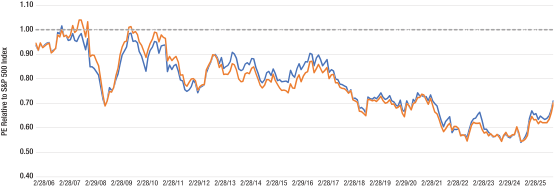
Valuation Differences Remain Significant
One of the most compelling arguments for international equities remains valuation. In our previous analysis, we highlighted that international equities traded at a substantial discount relative to U.S. equities.
As of early 2024, the MSCI EAFE Index traded at a price-to-earnings (PE) multiple more than 40% lower than the S&P 500 Index, representing one of the widest valuation gaps in recent decades.
Despite the recent improvement in international equity performance, valuation disparity between U.S. and international markets remain notable. U.S. equities continue to trade at elevated multiples relative to both their historical averages and international peers.
PE Relative to S&P 500 Index
12/31/1970 - 2/27/2026
Source: Pacer Advisors, FactSet
While valuation alone is not a catalyst for near-term market movements, it can meaningfully influence how markets evolve over the long run. Academic and empirical research has shown that starting valuations are a key driver of long-term equity returns, with lower valuation environments typically associated with higher subsequent return potential.
For U.S. equities, after an extended period of multiple expansion, elevated valuations may leave less room for error when expectations begin to adjust.
S&P 500 10-Year Forward Return vs. Valuation
12/31/1990 - 2/27/2026

Source: Pacer Advisors, Bloomberg
Market Concentration in the U.S.
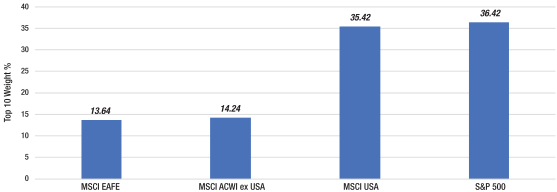
Another important structural difference between U.S. and international markets is the level of market concentration.
In recent years, the performance of the U.S. equity market has been heavily influenced by a small number of mega-cap companies. In contrast, international equity markets remain significantly less concentrated, with the largest companies representing a smaller portion of the overall index weight. This broader market composition provides investors with exposure to a wider set of business, sectors and regional growth drivers. As market leadership broadens, diversification may become increasingly valuable.
Top 10 Weights
2/27/2026
Source: Pacer Advisors, FactSet
Currency Dynamics and the U.S. Dollar
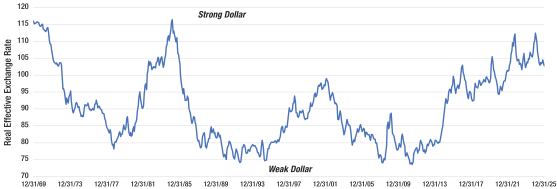
Currency movements play an important role in the relative performance of international equities for U.S. investors. From a return perspective, a weaker dollar increases the value of foreign assets when translated back into U.S. dollars, thereby enhancing returns. More broadly, dollar weakness is often associated with improved global liquidity conditions, which can support economic growth and equity markets outside the United States.
Historically, periods of U.S. dollar weakness have often coincided with stronger relative performance from international markets. For example, in 2025, the weak U.S. dollar contributed to 75% of the outperformance of MSCI EAFE and 51% of the outperformance of MSCI ACWI ex USA Index relative to the S&P 500.
Real Effective Exchange Rate, United States/Narrow Basket
12/31/1969 – 2/27/2026
Source: Pacer Advisors, Bloomberg, Bank for International Settlements
Cumulative Performance in Historical Currency Cycles
Cumulative Performance in Historical Currency Cycles
| MSCI USA Index |
MSCI EAFE Index |
EAFE Relative to USA |
U.S. Dollar Trend |
|
|---|---|---|---|---|
| Dec-69 - Oct-78 | 31.82% | 158.53% | 126.71% | Down |
| Oct-78 - Mar-85 | 156.98% | 81.97% | -75.01% | Up |
| Mar-85 - Aug-92 | 192.50% | 249.04% | 56.55% | Down |
| Aug-92 - Feb-02 | 226.27% | 62.57% | -163.71% | Up |
| Feb-02 - Jul-11 | 41.94% | 102.99% | 61.05% | Down |
| Jul-11 - Jan-25 | 502.58% | 116.75% | -385.83% | Up |
Source: Pacer Advisors, Bloomberg, Bank for International Settlements
Currency cycles also tend to persist over multi-year periods. While difficult to predict, there are early signs that the dollar’s strength may be moderating. In recent years, the dollar has been supported by higher U.S. interest rates, strong economic growth, and sustained capital inflows. However, as the Federal Reserve shifts toward a more accommodative stance and global interest rate differentials narrow, this support may begin to fade.
If the dollar were to enter a more sustained downcycle, it could provide a durable tailwind for international equities.
Investor Positioning
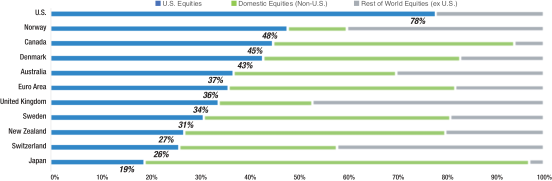
Another important consideration is investor positioning. U.S. investors have historically maintained a strong preference for domestic equities, a phenomenon commonly referred to as home bias.
Despite the global nature of modern capital markets, many U.S. portfolios allocate a disproportionately large share of equities to domestic stocks. While the U.S. represents roughly 60% of global equity markets (MSCI ACWI Index), U.S. investors typically allocate nearly 80% of their equity portfolios domestically.
This imbalance suggests that even modest shifts toward more globally diversified allocations could create incremental demand for international equities over time.
Equity Allocation Across Countries
December 2025
Source: How Investors Allocate Their Investments by Country
Structural Shifts Supporting International Markets
Beyond valuation and cyclical considerations, several structural developments across global markets may further support the case for international equities.
In Japan, ongoing corporate governance reforms have driven meaningful improvements in capital allocation, with companies increasing dividends and share buybacks. These changes have the potential to unlock value across the Japanese equity market.
In Europe, the increased defense spending, alongside large-scale investments in energy security and infrastructure, is creating new growth opportunities, particularly within the industrial sector.
At the same time, while the United States remains the center of artificial intelligence (AI) innovation, much of the global semiconductor and hardware supply chain sits outside the United States.
Companies in Taiwan, South Korea, Netherlands, and Japan play critical roles in enabling AI infrastructure, positioning them to benefit from continued growth in global computing demand.
Finally, global supply chains are undergoing gradual restructuring. As many multinational companies adopt “China + 1” strategies (expanding manufacturing into countries such as India, Vietnam, and Mexico) new investment and sources of growth may emerge across both emerging and developed markets.
Conclusion
Two years ago, the case for international equities was largely a valuation and diversification story. Today, early signs of improved performance are beginning to emerge alongside those structural drivers.
The combination of attractive valuations, broader market composition, supportive currency dynamics, and evolving macroeconomic conditions suggests that international equities may deserve renewed attention. For investors seeking diversification and long-term return potential, the global opportunity set may be becoming increasingly compelling.
Pacer ETFs offer a broad lineup of strategies designed to access international markets across a range of investment approaches. These include the Pacer Global Cash Cows Dividend ETF (GCOW), the Pacer Developed Markets International Cash Cows 100 ETF (ICOW), the Pacer Emerging Markets Cash Cows 100 ETF (ECOW), and the Pacer Developed Markets International Cash Cows Growth Leaders ETF (EAFG). Additional strategies include the Pacer Nasdaq International Patent Leaders ETF (PATN), the Pacer International Export Leaders ETF (PIEL), the Pacer Trendpilot International ETF (PTIN), and the Pacer Trendpilot European Index ETF (PTEU).
Together, these strategies provide investors with multiple ways to access international equities, whether through free cash flow–focused stock selection, innovation-driven leaders, or trend-based allocation approaches. As the opportunity set outside the U.S. continues to evolve, these funds may offer differentiated exposure aligned with the structural and cyclical dynamics highlighted above.
Download