


The PACER PERSPECTIVE
March 2025

| Tweet |
The Critical Role of Free Cash Flow
in Growth Investing
- Danke Wang, CFA, FRM, Portfolio Manager
When it comes to growth investing, sales growth is a critical factor for investors to consider, as it provides insights into a company’s business momentum and future potential.
While earnings growth is often highlighted, it cannot be sustained in the long run without corresponding sales growth. Relying exclusively on cost-cutting to improve profitability is not a viable strategy; instead, companies must achieve sales growth to ensure sustainable long-term financial performance
Investing in stocks with strong sales growth offers several benefits:
- Rapid sales growth suggests that a company is gaining market share, launching successful products, or entering new markets. This often signals a healthy and expanding business. For example, during its expansion phase, Tesla's strong sales growth in electric vehicles reflected rising consumer adoption and its market leadership, leading to significant stock appreciation despite high valuations.
- Sales growth typically precedes earnings growth. As revenue increases, companies benefit from economies of scale and improved operational efficiency, which drives higher profit over time. A prime example is Amazon, which despite its low profitability in the early days, focused heavily on growing its sales to lay the groundwork for its longterm dominance and eventual earnings growth.
While focusing on rapid top-line growth appears appealing to investors seeking long-term capital appreciation, historical performance data challenges this assumption.
For instance, when the S&P 500 is grouped into quartiles based on sales growth, the top sales growth cohort has consistently underperformed over different time periods.
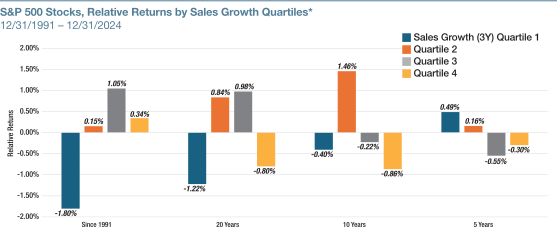
Source: FactSet, Pacer Advisors. *Quarterly data compounded to Annual Period
PAST PERFORMANCE IS NOT INDICATIVE OF FUTURE RESULTS. YOU CANNOT INVEST IN AN INDEX
There are several potential explanations. High sales growth companies tend to trade at higher valuations, making them vulnerable to downward rerating if market sentiment turns less favorable. In addition, current high growth rates may fade over time as companies mature or face competitive pressures.
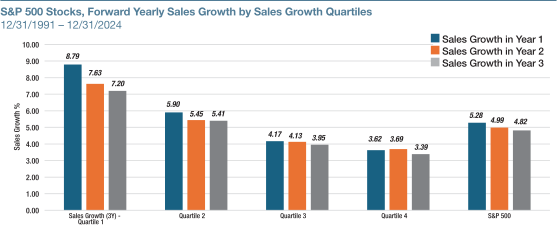
Source: FactSet, Pacer Advisors.
PAST PERFORMANCE IS NOT INDICATIVE OF FUTURE RESULTS. YOU CANNOT INVEST IN AN INDEX
A recent case is PDD Holdings (Temu), which reported an 86% surge in revenue and a 156% increase in profits in its quarterly earnings. Despite these leaps, management issued a note of caution, highlighting challenges in sustaining such growth amid intense eCommerce competition. This reveals a broader issue: high revenue growth, while impressive, is often difficult to maintain, especially in industries with significant competition and pricing pressures.
The above observations demonstrate that high sales growth alone is insufficient in acting as a reliable predictor of superior stock performance.
Then, what other factors should investors consider?
Balancing Sales Growth and Profitability
The tradeoff between growth and profitability is a common theme in business operations, where growth-focused companies often experience lower free cash flow margins (FCF / Sales, the proportion of revenue converted into free cash flow) due to substantial investments in business expansion. This can be seen in companies like Tesla and Amazon. Tesla reinvested heavily during its expansion phase to scale production and penetrate global markets. Similarly, Amazon focused on scaling its eCommerce and logistics infrastructure, sacrificing near-term profitability.
Despite these short-term tradeoffs, investors frequently reward such businesses with premium valuations, confident in the promise of future profitability fueled by their current growth trajectories.
While many companies sacrifice profitability to fund growth, an increasing number of firms are successfully balancing sales growth with robust FCF generation.
As highlighted in previous Pacer Perspective, five companies out of the Magnificent Seven -- Apple, Alphabet, NVIDIA, Meta, and Microsoft -- demonstrate an exceptional ability to sustain high FCF margins while achieving fast revenue growth.
This remarkable ability reflects a broader trend among growth-focused companies, particularly in the past two decades: the rise of capital-light business. Capital-light businesses rely less on traditional tangible assets like buildings and machinery, but instead leverage intangible assets such as intellectual property, software, and brand equity. With minimal maintenance capital requirement on fixed assets (lower CapEx), the companies generate substantial free cash flow, which can be reinvested in growth initiatives such as research and development, marketing, business innovation, and product improvement. Such investments further fueled their strong FCF generation. Moreover, by avoiding extensive capital investments, these businesses often carry lower levels of debt and financial leverage, enhancing their operational flexibility.
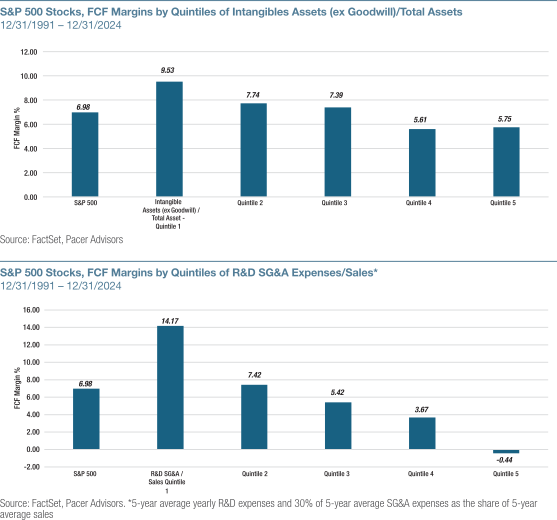
While sales growth remains an important indicator, FCF margin has emerged as an even more critical metric for evaluating growth investments. Companies that achieve both top-line growth and high FCF production demonstrate financial strength and the ability to self-finance business growth, ultimately creating sustainable value for shareholders.
When analyzing S&P 500 companies by segmenting them into four groups based on their sales growth and FCF margins, we observed that a combination of strong FCF generation and better-than-average revenue growth (High Sales Growth/High FCF Margin group) has consistently delivered good performances for investors. This is particularly evident in their relative performance over the past decade, where companies excelling in both metrics outperformed their peers.
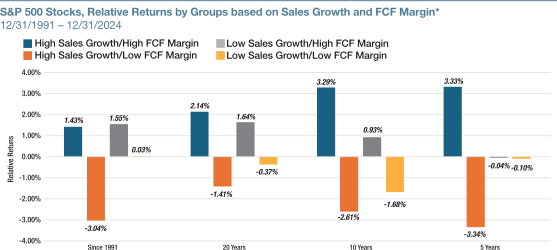
Source: FactSet, Pacer Advisors. *Quarterly data compounded to Annual Period
PAST PERFORMANCE IS NOT INDICATIVE OF FUTURE RESULTS. YOU CANNOT INVEST IN AN INDEX
Furthermore, the importance of FCF generation is especially pronounced among high-sales-growth companies. While the top quartile of sales growth companies in the S&P 500 Index often underperformed overall, those with top-tier FCF margins within this group delivered positive relative returns against the market benchmark. Conversely, high-growth companies with weak FCF generation (falling in the bottom tier of FCF margins) tended to lag, highlighting the pitfalls of prioritizing revenue expansion without sufficient cash flow.
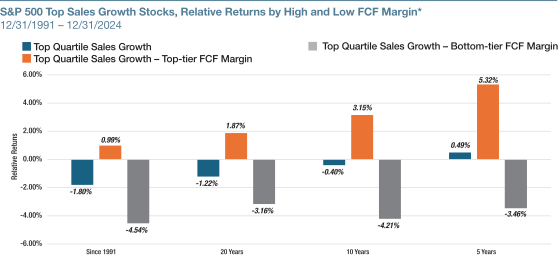
Source: FactSet, Pacer Advisors. *Quarterly data compounded to Annual Period
PAST PERFORMANCE IS NOT INDICATIVE OF FUTURE RESULTS. YOU CANNOT INVEST IN AN INDEX
In addition, it is essential to note, however, that prioritizing cash flow generation does not mean sacrificing sales growth. Previous research highlighted that companies with high FCF margins tend to maintain faster growth than peers. As shown in the chart, among high-sales-growth companies, those with the highest FCF margins actually delivered faster forward three-year sales growth. This dynamic again highlights that disciplined financial management, as reflected in robust FCF generation, can coexist with—or even support—accelerated top-line growth.
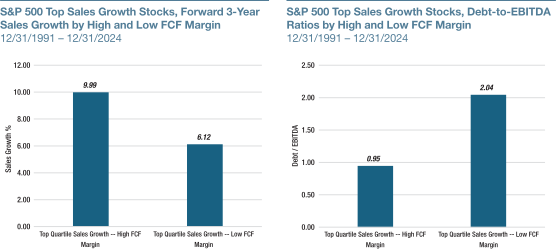
Source: FactSet, Pacer Advisors.
PAST PERFORMANCE IS NOT INDICATIVE OF FUTURE RESULTS. YOU CANNOT INVEST IN AN INDEX
On the other hand, companies that prioritize aggressive sales growth at the expense of free cash flow often rely on higher levels of leverage, which increases their financial risk. In contrast, high FCF margin companies reinvest their free cash flow to drive growth while minimizing their reliance on external funding. By maintaining strong cash flow margins, these businesses can deliver faster growth with lower financial risk, ultimately creating sustainable value for investors over the long term.
For investors looking to capitalize on the combination of growth and financial profitability, the Pacer Nasdaq-100 Top 50 Cash Cows Growth Leaders ETF (QQQG) is potentially a compelling solution. QQQG focuses on companies within the NASDAQ-100 Index that exhibit robust free cash flow generation (Higher FCF Margins). Historically, stocks with top-half FCF margins are quite competitive and have outperformed the rest of the NASDAQ-100 Index stocks over various time frames.
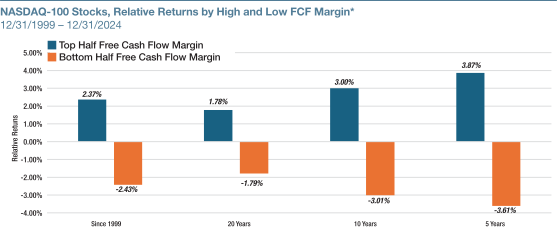
Source: FactSet, Pacer Advisors. *Quarterly data compounded to Annual Period
PAST PERFORMANCE IS NOT INDICATIVE OF FUTURE RESULTS. YOU CANNOT INVEST IN AN INDEX
By targeting growth companies with high FCF margin, QQQG provides investors with an opportunity to benefit from businesses that efficiently manage operations while self-funding their growth initiatives. This strategic focus makes QQQG an attractive option for those seeking sustainable value creation and longterm capital appreciation.

Free Cash Flow (FCF): A company’s cash flow from operations minus capital expenditures (expenses, interest, taxes, and long-term investments).
Free Cash Flow Margin: the FCF margin is a ratio that compares a company's free cash flow to its sales to understand the proportion of revenue that becomes free cash flow (FCF).
R&D Expense: Research and development expenses are direct expenditures relating to a company's efforts to develop, design, and enhance its products, services, technologies, or processes.
SG&A Expense: Selling, general, and administrative expenses includes all non-production expenses incurred by a company in any given period. It includes expenses such as accounting, management salaries, travel, advertising and marketing.
S&P 500 Price Return Index is a broad measure of U.S. large cap stocks, and does not include the reinvestment of dividends.
Nasdaq-100 Index is a globally recognized index that tracks the performance of 100 of the largest non-financial companies listed on the Nasdaq Stock Market®, encompassing a diverse range of industries and sectors
Nasdaq®, Nasdaq-100®, Nasdaq-100 Index®, and NDX® are registered trademarks of Nasdaq, Inc. (which with its affiliates is referred to as the “Corporations”) and are licensed for use by Index Design Group, LLC. The Product(s) have not been passed on by the Corporations as to their legality or suitability. The Product(s) are not issued, endorsed, sold, or promoted by the Corporations. THE CORPORATIONS MAKE NO WARRANTIES AND BEAR NO LIABILITY WITH RESPECT TO THE PRODUCT(S).
The financial instrument is not sponsored, promoted, sold or supported in any other manner by Solactive AG nor does Solactive AG offer any express or implicit guarantee or assurance either with regard to the results of using the Index and/or Index trade mark or the Index Price at any time or in any other respect. The Index is calculated and published by Solactive AG. Solactive AG uses its best efforts to ensure that the Index is calculated correctly. Irrespective of its obligations towards the Issuer, Solactive AG has no obligation to point out errors in the Index to third parties including but not limited to investors and/or financial intermediaries of the financial instrument. Neither publication of the Index by Solactive AG nor the licensing of the Index or Index trade mark for the purpose of use in connection with the financial instrument constitutes a recommendation by Solactive AG to invest capital in said financial instrument nor does it in any way represent an assurance or opinion of Solactive AG with regard to any investment in this financial instrument.
Download