


The PACER PERSPECTIVE
June 2024

| Tweet |
The One-take on ETF Liquidity
and Trading
– Chris Preston, Head: Trading and Portfolio Operations & Danke Wang, CFA, FRM, Portfolio Manager
Exchange-traded funds (ETFs) have become an increasingly popular investment vehicle among both individual and institutional investors. Understanding how to execute ETF trades efficiently is crucial for maximizing the benefits of intraday trading. This article seeks to simplify the complexities of the ETF market, clarify the concept of liquidity, and outline practical trading strategies to help investors make informed decisions.
ETF Market
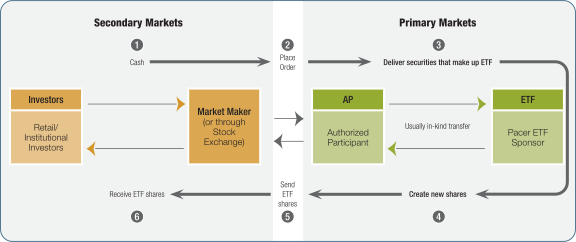
The ETF market is a complex ecosystem that includes various parties and processes that facilitate the trading and operation of these investment vehicles.
ETF issuers, the fund company who design and manage ETFs, and investors, are at both ends of the market structure, while other key components stand in between playing various roles and functions.
Market makers are specialized firms or entities that facilitate ETF trading by continuously quoting bid and ask prices for ETF shares on stock exchanges. They are essential for providing liquidity, narrowing bid-ask spreads, and ensuring investors may buy or sell shares at fair prices. Additionally, market makers may engage in arbitrage activities to profit from discrepancies between ETF prices and the value of their underlying assets.
Another important component to the ETF market is Authorized Participants (APs), which are specialized financial institutions that may also be market makers or brokerage firms. APs play a critical role in the creation and redemption process of ETF shares. They create new shares by delivering a basket of underlying securities to the ETF issuer or redeem existing shares by returning them to the issuer. This process helps keep the ETF’s market price close to its net asset value (NAV).
The creation and redemption of ETF shares occur in the primary market, ensuring that the supply of ETF shares may be adjusted to meet investor demand. In the secondary market, ETF shares are traded among investors on stock exchanges, similar to individual stocks. Market makers and other liquidity providers facilitate the trading by quoting bid and ask prices and providing necessary liquidity.
PAST PERFORMANCE IS NOT INDICATIVE OF FUTURE RESULTS. YOU CANNOT INVEST IN AN INDEX
Source: Pacer Advisors.
ETF Liquidity
The average daily volume (ADV) has traditionally been a strong indicator of liquidity for stocks, but it’s a common misconception that it’s the sole measure of an ETF’s liquidity. In reality, ETF liquidity extends beyond the visible trading volume of its shares.
ADV reflects only what has been traded, not what can be traded. Unlike stocks, which have a fixed number of shares, ETF shares may be created or redeemed based on investor demand, making the potential liquidity of an ETF much larger than its visible trading volume.
The true liquidity of an ETF is determined by the liquidity of the underlying securities in the portfolio. This concept is known as implied liquidity, which refers to the liquidity suggested by these underlying securities. Even if an ETF itself has a low trading volume, the liquidity of the underlying assets may provide substantial support for large trades. Market makers and APs leverage this implied liquidity to facilitate large transactions efficiently.
Furthermore, ETF liquidity exists in both the secondary and the primary markets.
Within the secondary market, market makers maintain continuous two-way (bid and ask) ETF orders in the order book, which lists all the market-makers quotes at different prices. However, these quotes represent only a small fraction of the volume they are willing to trade. Thus, investors may find that secondary market liquidity is much higher than the order book suggests. Meanwhile, for large ETF trades, investors may also access primary market liquidity by working with an AP to create or redeem ETF shares directly with the fund company. This dual-layer liquidity structure ensures that ETF trading can be robust and flexible, accommodating various investor demands.
ETF Trading
With ETF liquidity explained, it becomes clear that ETF trading involves more than simply buying and selling shares on the screen. Investors can choose between low-touch and high-touch orders, depending on their needs and the size of their trades.
Low-touch orders are typically executed electronically with minimal human intervention, suitable for smaller trades, often through automated trading systems or algorithms.
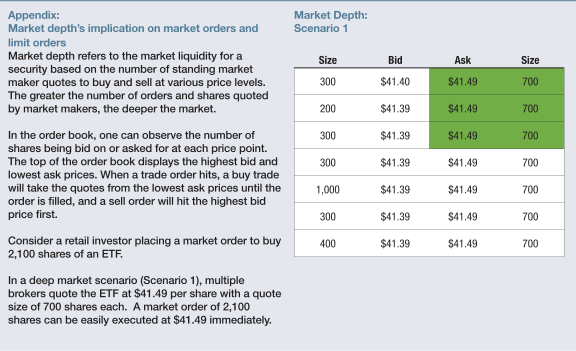
The most common order type among investors is the market order, which is executed immediately at the best available current price. For example, if a retail investor wants to buy 2,100 shares of an ETF immediately, they would place a market order, executing the trade at the current ask price. The primary advantage of market orders is their quick execution and simplicity. However, they carry the risk of bad trade execution when the market depth (see Appendix for market depth) is shallow, leading to a higher-than-expected purchase price or a lower-than-expected selling price.
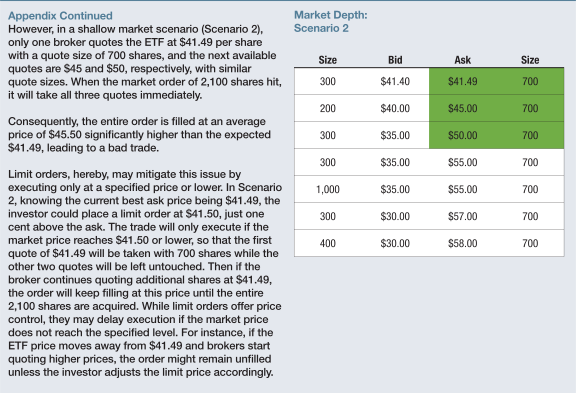
Given this backdrop, limit orders are widely recommended in ETF trading. Limit orders are executed only at a specified price or better, offering price control and protection even if the market depth is poor. However, limit orders may delay execution if the price does not reach the specified level, potentially causing missed opportunities if the price never hits the target.
Please see the appendix for more details about market depth’s implication on market orders and limit orders.
For larger trades, such as those exceeding 10,000 shares, the process can become complex and potentially detrimental if not managed properly. Therefore, a high-touch approach is often recommended, involving collaboration with a trading desk to execute the ETF order efficiently.
Large institutions often leverage a request-for-quote (RFQ) protocol to electronically solicit pricing for large transactions. RFQs allow investors to request detailed quotes from multiple liquidity providers, ensuring competitive pricing. For example, an investor looking to buy 200,000 shares of an ETF may use an RFQ platform to receive quotes from several market makers, ensuring they receive the best possible price for such a large order.
Regarding ETF trading strategies, the orders are generally done through risk trades and NAV (Net Asset Value) trades.
Risk Trade
In a risk trade, the market maker commits capital and assumes risk to facilitate the investor’s order immediately at a negotiated price.
For example, if an investor needs to buy 200,000 shares of an ETF by 11 a.m., they can consult their trading desk, which may determine that a risk trade is the best strategy. The trader then uses an RFQ platform to request risk trade quotes from several market makers. After pricing the basket of securities underlying the ETF and assessing the capital risk, ABC Securities may offer the entire trade at a two cents premium above the current ask price. Once the trader confirms with the investor, the order is executed without delay.
As mentioned earlier, market makers only quote a small fraction of the volume they are willing to trade in the order book. Risk trades enable investors to see the true depth of market-maker quotes, enabling immediate execution without market depth limitations. However, due to the higher risk assumed by the broker, risk trades often come with larger premiums (for buy trades) or discounts (for sell trades), especially in volatile or less liquid markets.
NAV Trade
NAV trades, on the other hand, execute based on the ETF’s NAV at the end of the day, suitable for investors who do not need immediate execution and are concerned about intraday volatility.
For instance, in a conversation with the trading desk, the investor expresses a preference for price certainty over trade speed when buying 200,000 shares of an ETF. The trading desk can send an RFQ for NAV trades. ABC Securities may respond with an offer of one cent above the NAV. After accepting the quote, the market maker completes the order once the fund’s NAV is calculated at the end of the trading day.
NAV trades align the trade price with the underlying asset value, avoiding market price fluctuations. Since the market maker assumes lower risk, NAV trades generally involve smaller premiums or discounts than risk trades. However, trade confirmations may not arrive until late at night or the next day due to the timing of NAV calculations. In some cases, due to late pricing or next day price adjustments, the ETF trading platform may disable NAV trades.
VWAP Trade
Besides risk and NAV trades, Volume-Weighted Average Price (VWAP) trades spread the transaction over the day, providing an average execution price.
VWAP trades are common in single-stock trading and are also useful for accumulating ETF shares. By distributing the order throughout the trading day, the investor can minimize market impact and achieve smoother execution. However, like NAV trades, VWAP trades do not execute immediately and may result in a higher average price compared to immediate risk trades.
One particular case of VWAP trades in trading ETFs is that the market makers can execute VWAP trades for the ETF’s underlying securities and then create ETF shares from the fund issuer. The average trading price of the underlying securities is passed on to the investor, making this strategy beneficial for extremely large trades, such as millions of shares.
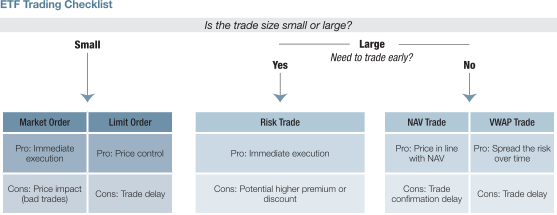
Choosing the most cost-effective way to execute ETF trades involves understanding the ETF market structure, recognizing the dual-layer liquidity, and selecting the appropriate trading strategy. For smaller trades, low-touch orders such as market and limit orders are appropriate. In contrast, larger trades benefit from a high-touch approach, including risk, NAV, and VWAP trades. Each method has its advantages and disadvantages, so investors must consider their specific needs, market conditions, and trading objectives to make informed decisions.
By leveraging the right execution strategy, investors can enhance their returns and manage risks more effectively in the dynamic ETF market.
This document does not take into account any investor’s particular investment objectives, strategies, tax status, or investment horizon. Please consult with your financial advisor and tax advisor before investing.
This document is not intended to be relied upon as a forecast, research or investment advice, and is not a recommendation, offer or solicitation to buy or sell any securities or to adopt any investment strategy. This document represents an assessment of the market environment at a specific time and is not intended to be a forecast of future events or a guarantee of future results. The user of this information assumes the entire risk of any use made of the information provided herein. There is no guarantee this strategy will be successful.
Download