


The PACER PERSPECTIVE
July 2025

Unlocking the Potential of Small-Cap Equities:
A Free Cash Flow Approach with CALF and CAFG
– Robert Keller, CFA, CAIA, Portfolio Manager
|
Strategic Insights |
|
Valuation Gaps Create Opportunity: Small-cap equities are trading at a steep discount to large caps, with the S&P 500’s forward P/E multiple near multi-decade highs relative to the Russell 2000. This valuation dislocation presents a compelling entry point for institutional investors seeking long-term value and an opportunity to rebalance away from concentrated, overvalued mega-cap exposures. Supportive Macro Conditions: The macroeconomic backdrop increasingly favors small caps, supported by above-trend GDP growth, a resilient labor market, easing inflation pressures, and improving market breadth. Onshoring, broader sector participation, and a declining risk of recession further strengthen the case for increased small-cap allocations. CALF and CAFG Offer Targeted Free Cash Flow Exposure: The Pacer U.S. Small Cap Cash Cows ETF (CALF) and the Growth Leaders ETF (CAFG) provide differentiated access to high-quality small-cap companies with strong free cash flow characteristics. CALF targets valuation and quality through free cash flow yield, while CAFG emphasizes operational efficiency and growth via free cash flow margin. |
This paper outlines our timely perspective on why current market conditions may be offering an attractive moment to re-engage with small-cap equities. Specifically, we highlight the Pacer U.S. Small Cap Cash Cows ETF (CALF) and Pacer US Small Cap Cash Cows Growth Leaders ETF (CAFG) as compelling investment vehicles, given their disciplined focus on free cash flow.
The macroeconomic backdrop is evolving in ways that increasingly favor small caps. While the Russell 2000® Index has trailed the S&P 500® Index over the last decade, we believe the recent underperformance sets the stage for a potential reversal. We present data and key market themes—such as strong economic growth, attractive valuations, onshoring trends, improving market breadth, and sector diversification—that support a constructive outlook for small-cap equities.
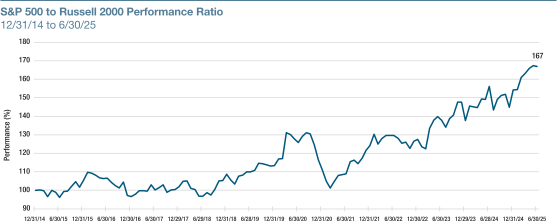
Pacer Advisors, Bloomberg
PAST PERFORMANCE IS NOT INDICATIVE OF FUTURE RESULTS. YOU CANNOT INVEST IN AN INDEX
Economic Growth
The current environment remains supportive of risk assets such as small-cap equities, as U.S. economic growth continues to accelerate. The Atlanta Fed’s GDPNow model projects above-trend growth for the second quarter of 2025, reinforcing a constructive macroeconomic backdrop. A resilient labor market continues to drive this momentum, with the U.S. adding 147,000 jobs in June, well above Bloomberg’s consensus estimate of 106,000. The unemployment rate declined to 4.1% in June, improving from 4.2% over the prior three months and beating expectations by 0.2%. Inflation pressures continue to ease, with year-over-year CPI at 2.6% and core Personal Consumption Expenditures (PCE)—the Fed’s preferred inflation gauge—at 2.7%. Both measures mark the slowest pace in nearly four years, indicating steady progress toward the Fed’s 2% target.
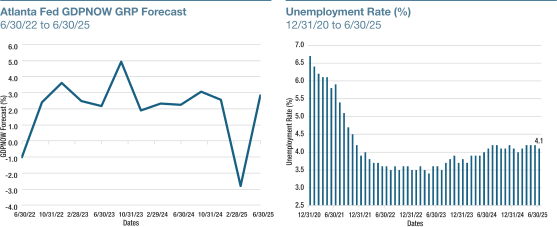
Chart Sources: Pacer Advisors, Bloomberg
PAST PERFORMANCE IS NOT INDICATIVE OF FUTURE RESULTS. YOU CANNOT INVEST IN AN INDEX
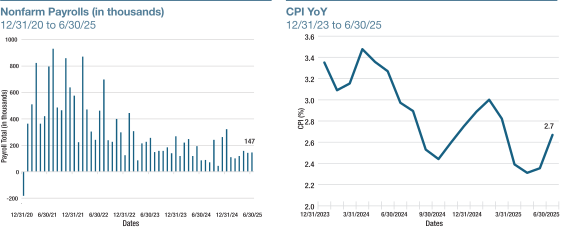
Chart Sources: Pacer Advisors, Bloomberg
PAST PERFORMANCE IS NOT INDICATIVE OF FUTURE RESULTS. YOU CANNOT INVEST IN AN INDEX
Credit markets are also supportive of a risk-on stance. Option-adjusted spreads (OAS) for both investment-grade and high-yield bonds have tightened and now trade below their five-year averages. This compression signals market confidence in the economic outlook and reflects a lower perceived risk of defaults.
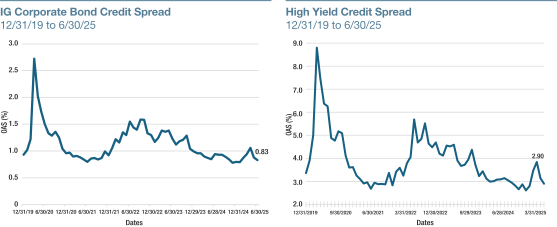
Chart Sources: Pacer Advisors, Bloomberg
PAST PERFORMANCE IS NOT INDICATIVE OF FUTURE RESULTS. YOU CANNOT INVEST IN AN INDEX
Importantly, the Russell 2000 differs meaningfully from the S&P 500—not only in market capitalization and sector composition, but also in small-cap stocks heightened sensitivity to domestic economic conditions. Roughly 40% of the Russell 2000 constituents are currently unprofitable, making the index more reliant on investor sentiment, access to capital, and expectations for U.S. economic growth. These companies often require external financing to fund operations, which amplifies their exposure to macroeconomic shifts and policy uncertainty.
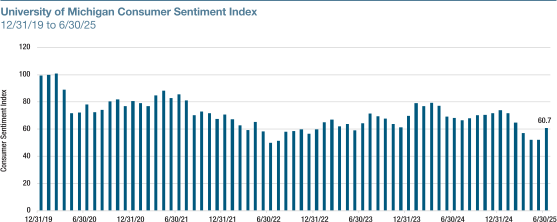
Consumer sentiment is showing signs of improvement. The University of Michigan Consumer Sentiment Index rose 8.3 points in June to 60.7, well above the consensus estimate of 53.5. The rebound suggests consumers are adapting positively to April’s tariff announcements and recent policy-related volatility, potentially supporting discretionary spending.
Source: Pacer Advisors, Bloomberg
PAST PERFORMANCE IS NOT INDICATIVE OF FUTURE RESULTS. YOU CANNOT INVEST IN AN INDEX
In contrast, nearly all S&P 500 constituents have maintained consistent profitability or demonstrated sufficient debt service coverage in recent years. This reduces the index’s reliance on favorable financing conditions and enhances its resilience during periods of economic uncertainty. Looking ahead, continued tariff de-escalation, the potential for lower effective interest rates, and tighter credit spreads could further support risk assets. These conditions may especially benefit small-cap equities, as economists continue to lower the probability of a near-term recession and revise tariff expectations downward from earlier initial estimates.
Valuations: Small-Cap Valuations Offer a Strategic Opportunity
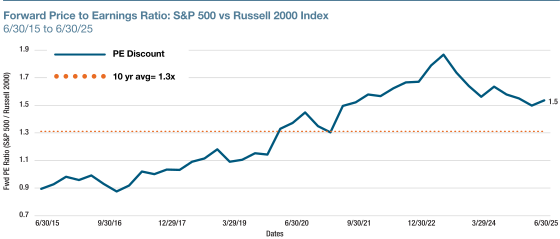
As of June 30, 2025, small-cap equities trade at historically attractive valuations relative to large caps. The forward price-to-earnings (P/E) ratio for the Russell 2000 stands at 17.0x, compared to 26.1x for the S&P 500. This represents a significant discount, with the S&P 500 trading at 1.54 times the valuation of the Russell 2000—near multi-decade highs. Over the past 10 years, this large-cap premium has averaged approximately 1.3x, making the current spread roughly one standard deviation above the long-term average.
This pronounced valuation gap highlights a compelling opportunity for portfolio repositioning. Investors can reduce exposure to overvalued large-cap equities—particularly in the concentrated and expensive technology sector—and reallocate toward more attractively priced small-cap stocks. Doing so can help correct valuation imbalances, improve portfolio diversification, and enhance long-term return potential.
Recent performance trends further support this view. Small-cap equities have meaningfully lagged large-caps in recent years, creating an increasingly favorable risk-reward profile. For long-term investors seeking undervalued assets with strong capital appreciation potential, small caps offer a timely and strategic allocation within a broader asset allocation framework.
Source: Pacer Advisors, Bloomberg
PAST PERFORMANCE IS NOT INDICATIVE OF FUTURE RESULTS. YOU CANNOT INVEST IN AN INDEX
Improving Market Breadth
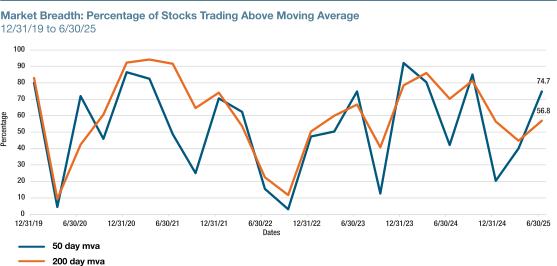
Market breadth continues to improve, signaling a healthier and more inclusive rally. As of June 30th, 75% of S&P 500 constituents trade above their 50-day moving average, while 57% trade above their 200-day average. The S&P 500 Equal Weight Index has kept pace, returning 4.8% year-to-date compared to 6.2% for the market-cap-weighted S&P 500.
This shift reflects a move away from narrow, mega-cap tech leadership toward broader participation across sectors and capitalizations. Small-cap equities have increasingly joined these rallies, contributing to performance and signaling expanding risk appetite. This broadening participation presents a timely opportunity to allocate toward overlooked segments—particularly small caps poised to benefit from improving sentiment, renewed investor interest, and a growing risk appetite.
Source: Pacer Advisors, Bloomberg
PAST PERFORMANCE IS NOT INDICATIVE OF FUTURE RESULTS. YOU CANNOT INVEST IN AN INDEX
Sector Diversification
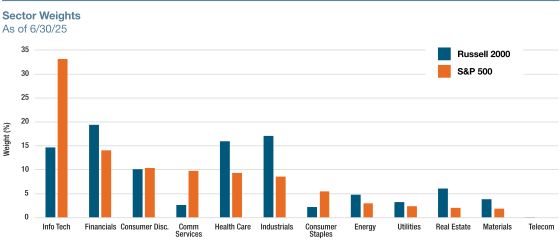
Sector composition continues to distinguish small-cap from large-cap equities. Technology remains the largest sector in the S&P 500, representing 33.1% of the index as of June 30, 2025, compared to just 14.7% in the Russell 2000. In contrast, the Russell 2000 allocates more heavily to cyclical and economically sensitive sectors. Industrials account for 17.1% of the index versus 8.6% in the S&P 500, Materials 3.8% versus 1.9%, Energy 4.8% versus 3.0%, and Health Care 15.9% versus 9.3%. This broader, more balanced sector exposure may provide a strategic advantage across varying phases of the market cycle.
Recent economic data highlights the impact of this sector tilt. While small caps remain underexposed to Technology, they maintain higher allocations to sectors poised to benefit from an economic recovery and onshoring trends. As supply chains shift in response to rising international tariffs, domestic-oriented sectors, such as Industrials, Materials, and Healthcare, stand to gain. With macro conditions stabilizing and market breadth improving, these areas could lead a resurgence in small-cap performance.
Allocating to small caps may enhance portfolio diversification and reduce exposure to the concentrated, and often expensive, Technology segment of the market.
Source: Pacer Advisors, Factset
PAST PERFORMANCE IS NOT INDICATIVE OF FUTURE RESULTS. YOU CANNOT INVEST IN AN INDEX
Mergers & Acquisitions (M&A)
M&A activity has remained muted in recent years, held back by interest rate uncertainty and increased regulatory scrutiny. However, signs of a rebound are emerging. According to a recent Bloomberg report, Citi’s M&A Target Index has risen more than 25% since April 30, 2025, reflecting growing confidence in a more constructive deal-making environment. A more stable interest rate environment and the potential for pro-business policy shifts could further support this trend.
Wall Street banks are reporting stronger deal pipelines and renewed momentum, reflecting increased confidence across capital markets. The foundations of a sustained M&A recovery appear to be taking shape.
Small-cap companies are particularly well-positioned to benefit from this improving environment. Many trade at discounted valuations and offer compelling attributes such as innovation, scalable growth potential, and niche market leadership—traits that appeal to both strategic acquirers and private equity buyers. As deal activity gains traction, demand for high-quality small caps may rise, potentially driving price appreciation and renewed institutional flows into the asset class.
For small-cap investors, an uptick in M&A activity presents a dual benefit: acquisition premiums and broader validation of the asset class’s value. In today’s environment, small caps offer not only long-term growth potential but also timely exposure to a revitalizing corporate transaction landscape.
The CALF ETF and the CAFG ETF offer investors a differentiated approach to small-cap equity investing by targeting companies with strong free cash flow characteristics—specifically, free cash flow yield (CALF) and free cash flow margin (CAFG).
High free cash flow, whether measured by yield or margin, indicates a company’s ability to generate excess cash beyond what is needed to maintain operations. This surplus enables management to reinvest in growth, reduce leverage, fund research activities, return capital to shareholders, or pursue strategic acquisitions.
The CALF ETF focuses on quality by selecting small-cap companies with robust free cash flow yields (free cash flow/enterprise value). This strategy provides exposure to attractively valued businesses that often trade at a discount relative to the broader small-cap universe.
In contrast, the CAFG ETF identifies top growth candidates within the small-cap space by screening for above-average free cash flow margins (free cash flow/sales). Companies with high FCF margins typically demonstrate operational efficiency and strong cash conversion, positioning them for stronger current and future revenue and earnings growth. Together, CALF and CAFG offer complementary frameworks for capturing both value and growth within the small-cap segment—grounded in free cash flow discipline.
Attractive Valuations
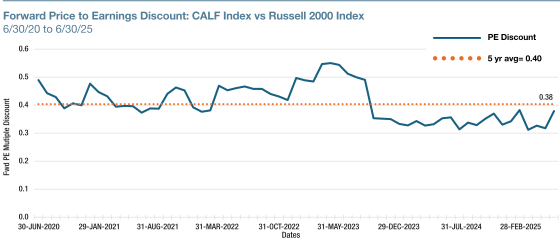
The CALF Index currently trades at an approximate 38% discount to the broader Russell 2000 Index on a forward P/E basis, presenting a potentially compelling risk-reward opportunity. Over the past five years, this valuation discount has averaged nearly 40%. By targeting high-quality small-cap companies with strong free cash flow at attractive valuations, the CALF Index offers exposure to businesses that may help mitigate portfolio risk with meaningful upside potential, particularly when compared to the broader small-cap universe.
Source: Pacer Advisors, Factset
PAST PERFORMANCE IS NOT INDICATIVE OF FUTURE RESULTS. YOU CANNOT INVEST IN AN INDEX
Stronger Free Cash Flows: High FCF Yield as a Competitive Advantage
In a higher-rate environment, companies with strong free cash flow (FCF) yield and margin are better positioned. Robust cash generation supports healthier debt service ratios—particularly important for small caps, which tend to carry higher leverage. These companies also have greater flexibility to absorb external cost pressures, such as tariffs, helping to preserve margins.
Currently, more than 40% of Russell 2000 constituents are unprofitable, a dynamic largely attributable to the index’s sector composition. A significant allocation to Health Care—particularly early-stage biotech firms—contributes to the elevated number of unprofitable enterprises. As a result, many of these companies face increased borrowing needs, higher leverage, and reduced capacity to service debt. In fact, roughly half the index constituents failed to generate sufficient operating income (using EBIT as a proxy) to cover prior-year interest expenses. This underscores a growing reliance on external capital and limits reinvestment flexibility.
By contrast, small-cap companies with strong FCF are better equipped to fund operations internally, reducing their reliance on external financing and mitigating refinancing risk. With Net Debt/EBITDA ratios elevated and interest coverage weakening across the small-cap universe, FCF strength has become an increasingly critical indicator of financial resilience. The CALF and CAFG ETFs provide targeted exposure to high-quality small-cap companies with strong FCF yield and margin. This focused approach seeks to capture businesses with durable financial profiles—better positioned to navigate rising rates and tightening credit conditions than their small-cap peers.
CALF ETF: Strong Performance & Methodology Enhancement
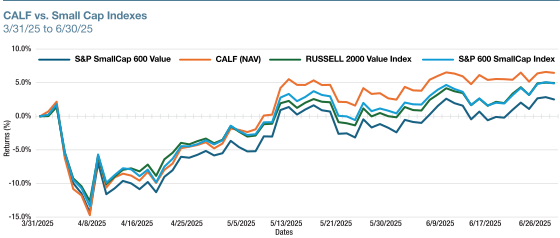
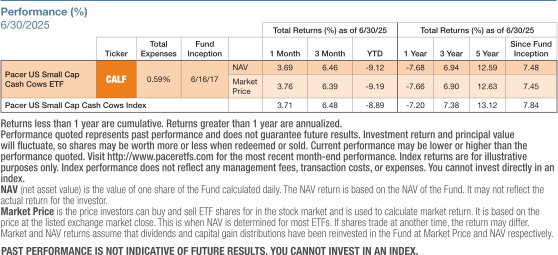
Since March 31, 2025, the CALF ETF (Based on NAV) has outperformed the S&P SmallCap 600 Value Index by 3.9% and the Russell 2000 Value Index by 1.5%, reflecting strong relative strength and positive momentum. As of June 30, 2025, CALF also posted a quarter-to-date return of 6.5%, outperforming the broader S&P 600 Index return of 4.9%. These results are highlighted in the performance snapshot below.
CALF recently updated its investment methodology to enhance portfolio liquidity and broaden diversification. The fund previously selected the top 100 small-cap stocks by free cash flow yield from the S&P SmallCap 600 Index. Under the new approach, the universe expands to include more than 2,000 U.S. small-cap companies. From this broader set, CALF now selects the top 200 stocks based on free cash flow yield.
In addition to expanding the investment universe, the updated methodology introduces new constraints based on company market capitalization and free float. These restrictions limit CALF's exposure to any single company's tradable equity, reducing the risk of concentrated positions in less liquid names.
This change serves multiple purposes. By broadening the investable universe and increasing the number of holdings, CALF reduces position sizes relative to available float, improving liquidity and limiting market impact. This leads to tighter bid-ask spreads and allows securities to trade closer to fair value. The updated methodology also enhances diversification across individual securities and sectors, reducing concentration risk and improving benchmark tracking. Early performance following the change has been strong, underscoring the benefits of the revised strategy.
Source: Pacer Advisors, Bloomberg
PAST PERFORMANCE IS NOT INDICATIVE OF FUTURE RESULTS. YOU CANNOT INVEST IN AN INDEX
Summary:
We believe the macro backdrop increasingly favors small-cap equities, supported by accelerating economic growth, easing tariff concerns, broadening market participation, and attractive relative valuations.
CALF and CAFG offer distinct, yet complementary, approaches to small-cap investing, as each are grounded in free cash flow fundamentals.
CALF targets companies with high free cash flow yield, prioritizing quality, valuation discipline, and downside resilience. In contrast, CAFG selects businesses with strong free cash flow margins, favoring operational efficiency and the potential for stronger current and future revenue and earnings growth.
Together, these strategies provide institutional investors with differentiated exposure to high-quality, cash-generative small-cap companies positioned for potential leadership in the next phase of the market cycle.
S&P SmallCap 600 Index - The Standard & Poor's Smallcap 600 Index is a capitalization-weighted index that measures the performance of selected U.S. stocks with a small market capitalization.
S&P 600 Value Index - The S&P SmallCap 600 Value Index is a market capitalization weighted index. All the stocks in the underlying parent index are allocated into value or growth. Stocks that do not have pure value or pure growth characteristics have their market caps distributed between the value & growth indices.
S&P 500 Index - The S&P 500® is widely regarded as the best single gauge of large-cap U.S. equities and serves as the foundation for a wide range of investment products. The index includes 500 leading companies in the US market.
Russell 2000 Index - The Russell 2000 Index is comprised of the smallest 2000 companies in the Russell 3000 Index.
EBITDA (Earnings Before Interest, Taxes, Depreciation, and Amortization): A financial metric used to evaluate a company's core operating performance by excluding interest, taxes, depreciation, and amortization. It serves as an alternative to net income, offering a clearer view of profitability and operational efficiency.
Net debt-to-EBITDA: A leverage ratio that compares a company’s net debt to its EBITDA. It indicates a company's ability to service its debt, with lower values generally suggesting stronger financial health and greater capacity to meet debt obligations.
Download