


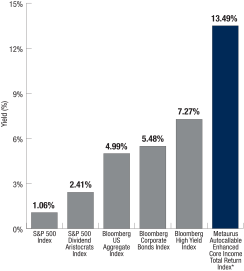
The Autocallable Potential for Higher Yield
as of 8/31/26
Autocallable Characteristics
- Potential High Monthly Income:
Seeks to generate conditional coupon income. - Capped Upside:
Upside participation is capped, even in strong markets. - Conditional Downside Protection:
Offers full autocallable principal protection against losses above a predefined barrier. - Risk Below Coupon Barrier:
Full downside risk applies if the underlying Reference Index falls below the barrier. Coupons may be skipped. - Reference Index:
An autocallable ETF provides exposure to a portfolio of autocallable investments linked to the performance of a Reference Index.
Pacer Metaurus Autocallable Design
- 50% Coupon Barrier¹:
Coupons are conditionally paid so long as the individual autocallable remains above the barrier as determined by the Reference Index - Coupon Memory Feature:
Skipped coupons are not necessarily forfeited but accumulated and stored. They may be paid later if the Reference Index recovers above the Coupon Barrier. - 6-Month Non-Call Period:
Within the first six months, each of the autocallables cannot be called, even if they are above the autocall level. - 5-Year Maturity:
Each autocallable has a maturity of five years from its individual issue date. - Laddered Autocallable Exposure:
Designed to diversify the barrier risk across multiple positions.
Source: Metaurus, Pacer Advisors
*Yield represents weighted average coupon for the Metaurus Autocallable High Income Total Return Index. The Metaurus Autocallable High Income Total Return Index should not be considered a proxy for ACBH. Yield on the underlying index is not guaranteed.
(¹)Coupon Barrier: The predetermined level of the Underlying Reference Index below which the Coupon will not be paid on a specified Observation Date.
How do our Autocallable ETFs Work?
Individual Autocallables are generally issued weekly with the following:
- Starting reference level
- Predefined downside Coupon Barrier
- Monthly observation dates
- 5-year maturity
- 6-month non-call period (time before a position can be autocalled)
- Coupon Memory Feature
Hypothetical Example of how the Pacer Metaurus Autocallable Strategy works:
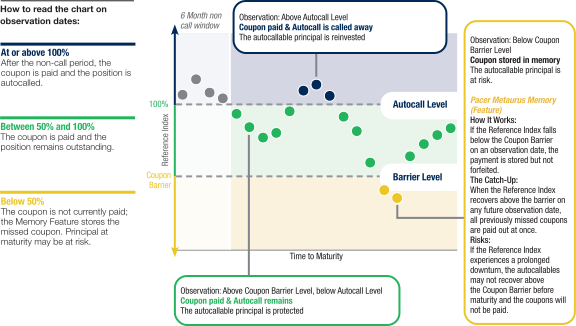
This is a hypothetical illustration and does not demonstrate historical or future performance data. It does not include fees or expenses.
Reference Index: The Metaurus US Large Cap VolPathSM Index is designed to provide systematic, volatility-adjusted exposure to E-Mini S&P 500 futures contracts by targeting a realized volatility level of 40%, subject to a 0.011% daily decrement (4% annualized). The Index is designed to dynamically adjust exposure as market conditions change, seeking to participate more fully in calmer environments while reducing exposure when volatility rises. A targeted volatility approach seeks to support a more stable and consistent coupon level for autocallable products. At the core of the VolPath Index is a modern volatility-estimation approach that places greater emphasis on recent market behavior. Compared with traditional fixed-window volatility models, this framework can deliver a more adaptive signal—an important advantage for risk management, trading, and volatility-control strategies that require timely response to changing market regimes. With daily rebalancing and two optimized decay factors calibrated to balance responsiveness and stability, the VolPath Index is built for practical implementation in today’s market environment. Its rules-based design is intended to help smooth transitions across volatility regimes, support disciplined exposure management, and serve as a scalable tool for portfolio overlays, trading applications, and volatility-controlled investment solutions.
The Fund seeks to track an index designed to replicate a laddered autocallable strategy. The Fund does not invest directly in autocallables. Instead, it obtains exposure primarily through swap agreements that track an index of equivalent autocallables. Embedded features—including the barrier, non-call period, and autocall level—limit potential appreciation, with the maximum payout from each autocallable limited to the coupons received and the contingent return of original principal. If an autocallable is autocalled, investors receive their original principal in full plus the coupon then due. No additional coupons accrue, and the proceeds may be reinvested on less favorable terms than those offered by the redeemed autocallable. If an autocallable reaches maturity, the return of principal depends on where the reference index closes relative to the barrier on the final observation date. If the index closes at or above the barrier, original principal is returned in full. If the index closes below the barrier, investors participate one-for-one in the index’s decline from its initial level, resulting in a loss of principal.
ACBE Autocallable Dashboard
loading...
| Full Horizon Active Horizon |
TBD%
Weighted Avg. Coupon
TBD%
Autocallables above Coupon Barrier
TBD%
Coupon Barrier
TBD
Live Autocallables
Performance (%)
as of 09/30/2026
| Since Fund Inception (9/9/26) | YTD | 1 Month | 3 Month | 1 Year | ||||
|---|---|---|---|---|---|---|---|---|
| Pacer Metaurus Enhanced Core Income Autocallable ETF NAV | -0.04 | N/A | N/A | N/A | N/A | |||
| Pacer Metaurus Enhanced Core Income Autocallable ETF Market Price | 0.18 | N/A | N/A | N/A | N/A | |||
| S&P 500 | 0.26 | 12.75 | -0.35 | 2.30 | 15.74 | |||
|
This is a new fund and has limited performance to report. Performance quoted represents past performance and does not guarantee future results. Investment return and principal value will fluctuate, so shares may be worth more or less when redeemed or sold. Current performance may be lower or higher than the performance quoted. Visit www.paceretfs.com for the most recent month-end performance. Index returns are for illustrative purposes only. Index performance does not reflect any management fees, transaction costs or expenses. You cannot invest directly in an index. |
||||||||
Top 10 Holdings (%)
as of 6/30/17
View All Holdings
| Ticker | Holding | Weight |
|---|---|---|
| loading... |
Top Asset Allocation (%)
as of 6/22/2026
To view a sector's breakdown, please select a slice. To return to the total breakdown, select 'Sector Breakdown' below. Please note, the sector table below only shows total sector weights.
Reference Index: The Metaurus US Large Cap VolPathSM Index is designed to provide systematic, volatility-adjusted exposure to E-Mini S&P 500 futures contracts by targeting an implied volatility level of 40%, subject to a 4% annual decrement. The Index is designed to dynamically adjust exposure as market conditions change—seeking to participate more fully in calmer environments while reducing exposure when volatility rises. At the core of the VolPathSM Index is an exponentially weighted moving average (EWMA) framework, a modern volatility-estimation approach that places greater emphasis on recent market behavior. Compared with traditional fixed-window volatility models, EWMA can deliver a more adaptive signal—an important advantage for risk management, trading, and volatility-control strategies that require timely response to changing market regimes. With daily rebalancing and two optimized decay factors calibrated to balance responsiveness and stability, the VolPathSM Index is built for practical implementation in today’s market environment. Its rules-based design is intended to help smooth transitions across volatility regimes, support disciplined exposure management, and serve as a scalable tool for portfolio overlays, trading applications, and volatility-controlled investment solutions.
Observation Date: A scheduled date after the Non-Call Period when an autocallable is evaluated for early redemption, typically monthly or quarterly
Coupon Percentage: The percentage number that determines the size of the Coupon to be made on specified Observation Dates, if the relevant payout and return characteristics have been met (the “Coupon”).
Flexible Exchange® Options (“FLEX Options”) are customizable exchange-traded option contracts guaranteed for settlement by the Options Clearing Corporation (the “OCC”). The OCC guarantees performance by each of the counterparties to the FLEX Options, becoming the “buyer for every seller and the seller for every buyer,” with the goal of protecting clearing members and options traders from counterparty risk. Although guaranteed for settlement by the OCC, FLEX Options are still subject to counterparty risk with the OCC and subject to the risk that the OCC may fail to perform the settlement of the FLEX Options due to bankruptcy or other adverse reasons. The FLEX Options that the Fund will hold and that reference the SPDR® S&P 500® ETF Trust (“SPY”) will give the Fund the right or the obligation to either receive or deliver shares of SPY, or the right or the obligation to either receive or deliver a cash payment on the option expiration date based upon the difference between SPY’s value and a strike price, depending on whether the option is a put or call option and whether the Fund purchases or sells the option. The Fund will purchase call options (giving the Fund the right to receive shares of SPY or a cash payment) and put options (giving the Fund the right to deliver shares of SPY or a cash payment), and may sell (i.e., write) call options (giving the Fund the obligation to deliver shares of SPY or a cash payment) and put options (giving the Fund the obligation to receive shares of SPY or a cash payment) in instances where it is deemed necessary or desirable to construct the Box Spread. In instances where the purchased call and put options are substantially in-the-money and the synthetic long and short positions comprising the Box Spread can effectively be constructed without writing call or put options, the Fund may elect not to write call or put options. The Fund intends to use FLEX Options in constructing Box Spreads. The Fund receives premiums in exchange for the written FLEX Options and pays premiums in exchange for the purchased FLEX Options. The OCC and securities exchanges on which the FLEX Options are listed do not charge ongoing fees to writers or purchasers of the FLEX Options during their life for continuing to hold the option contracts but may charge transaction fees.
The Fund intends to make monthly distributions that generally reflect the income generated by the index, net of expenses. Distributions are not guaranteed, may vary significantly and may consist of ordinary income, return of capital or both. Because distributions reduce the Fund’s NAV, repeated distributions, particularly when they exceed the Fund’s gains, may materially erode the Fund’s NAV, trading price and an investor’s principal over time. A return of capital generally reduces a shareholder’s tax basis and may result in a higher taxable gain or lower taxable loss when shares are sold.
Distributions
|
Past distributions are not indicative of future distributions. |