


The PACER PERSPECTIVE
Market Summary 2022

FOR FINANCIAL ADVISOR USE ONLY. NOT FOR USE WITH THE INVESTING PUBLIC.
Investing Through Uncertainty –
2022 Review and 2023 Opportunities
- Aidan O’Hara, Investment Research and Institutional Sales
2022 was a year of increased inflation, tightening monetary policy, strong labor markets, continued supply chain disruptions, and volatile capital markets. Most major indices declined substantially from the all-time highs set in 2021, with the S&P 500 falling (-18.11%) and the Nasdaq 100 Index falling (-32.38%) in 2022.
Economies across the globe continued to reopen following the Covid-19 pandemic, increasing demand for commodities and straining already tight markets. Supply-demand imbalances in energy markets like oil and natural gas were exacerbated by the Russian invasion of Ukraine, which put upward pressure on food and energy prices at the beginning of the year. This accelerated the pace of inflation, which began the year at elevated levels. As a result, the Energy sector continued its winning streak, returning (+65.72%), which was by far the highest returns of any sector in the S&P 500. In fact, Energy was one of only two sectors in the S&P 500 with positive returns in 2022, followed by Utilities (+1.57%), then Consumer Staples (-1.39%), and Healthcare (-1.95%).
Unsurprisingly, the primary focus of financial markets in 2022 was historically high inflation and central bank policies. Consensus expectations heading into the year called for inflation to moderate rapidly. Instead, inflation continued to climb higher for much of the year, reaching levels which hadn’t been seen since the ‘Great Inflation’ period of 1967 – 1982. Unexpectedly high inflation put pressure on global central banks to tighten monetary policy swiftly and aggressively. At their December 2021 meeting, the FOMC laid out their forecasts for 2022. At that meeting, FOMC members projected the average inflation rate in 2022 would be 2.6%, and projected the Fed funds rate would rise to 0.9% by the end 20221. Instead, headline inflation in the US averaged 8.02% in 2022, peaking at 9.1% in June 2022 before decelerating to 6.5% in December. The Fed responded to higher than expected inflation by hiking the Fed funds rate 7 times in 2022, blowing past their projections and bringing the target range to 4.25-4.5% by year end.
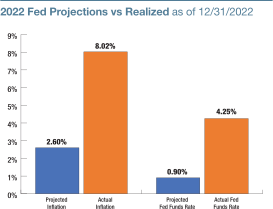
PAST PERFORMANCE IS NOT INDICATIVE OF FUTURE RESULTS. YOU CANNOT INVEST IN AN INDEX
Source: Bloomberg. https://www.federalreserve.gov/monetarypolicy/fomcpresconf20211215.htm, 4.25% is FFR lower bound
Persistent inflation and an unexpectedly hawkish response from the Fed sent shockwaves through both equity and fixed income markets. As a result, a traditional portfolio of 60% stocks and 40% bonds had one of the worst years on record in 2022, returning (-15.91%). Higher discount rates in the form of higher interest rates and elevated inflation put downward pressure on stock prices, which entered the year at some of the highest valuations since the dot-com bubble.
Equity Market Returns and Valuation Metrics
as of 12/30/2022
| S&P 500 | Nasdaq 100 | Russell 1000 | Russell 1000 Value | Russell 1000 Growth | MSCI All World ex-US Index | Russell 2000 | S&P 500 Technology | S&P 500 Energy | 60/40 Portfolio | |
| 2022 Performance | -18.11% | -32.38% | -19.13% | -7.54% | -29.14% | -16.00% | -20.44% | -28.41% | 65.72% | -15.91% |
| 5-Yr Annualized Performance | 9.41% | 12.34% | 9.12% | 6.66% | 10.95% | 0.88% | 4.12% | 15.38% | 9.24% | 6.07% |
| 10-Yr Annualized Performance | 12.56% | 16.44% | 12.37% | 10.29% | 14.10% | 3.80% | 9.01% | 17.83% | 5.97% | 8.13% |
| Forward P/E Beginning of 2022 | 22.72 | 30.23 | 23.14 | 17.22 | 33.33 | 14.99 | 16.04 | 29.36 | 14.03 | - |
| Forward P/E End of 2022 | 17.43 | 21.98 | 17.67 | 14.49 | 23.11 | 11.98 | 11.46 | 21.21 | 8.40 | - |
| 5-Yr Avg Fwd P/E | 19.77 | 24.59 | 20.25 | 16.52 | 25.88 | 14.74 | 16.06 | 22.90 | 18.82 | - |
| 10-Yr Avg Fwd P/E | 18.41 | 21.84 | 18.86 | 16.19 | 22.67 | 14.55 | 17.20 | 19.71 | 29.38 | - |
Source: FactSet, Bloomberg
Fixed Income Yield and Return Metrics
as of 12/30/2022
| BBG AGG Index | 10yr Treasury | 90 Day T-Bills | Bloomberg High Yield Corporate Bond Index | |
| 2022 Return | -13.01% | -14.98% | 1.52% | -11.19% |
| 2022 Beginning Yield to Maturity (YTM) | 1.76% | 1.51% | 0.04% | 4.86% |
| 2022 Ending YTM | 4.68% | 3.87% | 4.22% | 8.99% |
| 2022 Peak Yield | 5.21% | 4.24% | 4.22% | 9.92% |
Source: FactSet, Bloomberg
Supply chain issues, which have persisted since the advent of the Covid-19 pandemic, continued throughout 2022. The most notable shocks to supply chains in 2022 were caused by the Russian invasion of Ukraine in February and the continuation of lockdowns in China stemming from strict Zero-Covid policies. NATO nations responded to the Russian invasion of Ukraine by imposing economic sanctions on Russia. Energy and food costs across the globe spiked as a result, with WTI crude rising as high as $130/barrel in early March, before retreating in the second half of the year.
The Russian invasion of Ukraine had an outsized impact on European nations, which had become reliant on Russian energy. The price of natural gas in Europe peaked at the highest level ever recorded on 8/25/2022, spiking over 450% from the beginning of the year before declining substantially to round out 2022. Rising food and energy prices accelerated the pace of inflation in the Eurozone and the UK, both of which saw inflation peak later in the year and at higher levels than in the US.
Bad news from record high inflation was offset by good news in the labor market, with the US unemployment rate decreasing to a 50-year low of (3.5%) in July, September, and again in December. Tightness in the labor market was evidenced by the number of job openings per unemployed worker, which stood at over 1.72 in December after reaching an all-time high earlier in the year. Strength in the labor market continues to put pressure on the Fed to increase rates as they fight to cool inflation. Earnings remained resilient through 2022, though forward-looking guidance has become increasingly negative as companies anticipate the delayed effects of rate hikes and tighter financial conditions on the broader economy.
Navigating 2023
Many market participants remain uncertain of what to expect in 2023. Although inflation has seemingly peaked, uncertainties remain around the pace at which inflation will slow and the level at which it will normalize. Uncertainties also remain around what central bank policy will look like in 2023. Last year, the Fed sent a clear message to markets, stating their priority was a rapid return to stable prices. Many believe restoring price stability will require the Fed to cause an economic slowdown and a softening of the labor market. As such, the hawkish tone from the Fed shifted the focus of investors to whether the US economy will enter a recession in 2023. The question now is: if the US economy enters a recession, how severe will it be? The debate has shifted to wondering if the Fed can engineer a “soft landing”, ie can they cool inflation without inducing a steep recession? The downstream effects of a slowing economy are a concern to financial market participants – if the US economy does enter a recession, how will it affect corporate earnings, and how will it affect investors’ risk appetites?
Earnings
Many strategists are predicting 2023 will be a tale of two cities, beginning with a downturn in the first half of the year followed by a recovery in the second half. There’s generally a lag between when monetary policy is enacted and when the effects are finally felt by the broader economy. As such, strategists expect companies to feel the effects of tighter monetary policy in the first half of 2023. Investors are paying close attention as earnings season begins, with some of their primary concerns as follows: how will elevated inflation and higher borrowing costs affect corporate profit margins? How will inflation and the aggressive monetary policy enacted in 2022 affect overall economic activity, consumer spending, and investor behavior?
According to Factset, as of Jan 6th, the estimated (year-over-year) earnings growth rate for Calendar Year (CY) 2022 remains in positive territory at (4.7%). However, analysts are projecting earnings declines of (-4.1%) as companies report Q4 2022 results, and further declines of (-1.1%) and (-1.2%) for Q1 and Q2 2023, respectively. For perspective, the 5-year average earnings growth rate is (+14.1%) and the 10-year average earnings growth rate is (+8.9%). As mentioned previously, strategists expect 2023 will be a two-part story, anticipating the negative earnings trend will reverse course during the second half of the year, with expected earnings growth of (+4.2%) for CY 2023.
Another trend worth noting is the persistence of negative earnings revisions. Since mid-2022, analysts have been steadily lowering their forward-looking Earnings Per Share (EPS) estimates. According to FactSet, analysts lowered their (year-over-year) earnings estimates for Q4 2022 from (+3.5%) on September 30th, to (-4.1%) as of December 31. Analysts also lowered their CY 2023 EPS estimates by (-4.4%) over the same timeframe. Such revisions may warrant caution for investors, especially when one considers the S&P 500 was up (7.56%) in Q4 2022. The divergence in S&P 500 performance and CY2023 EPS estimates persisted in January 2023, with the S&P 500 up an additional (6.28%) to start the year while companies continued revising their CY2023 EPS estimates lower.
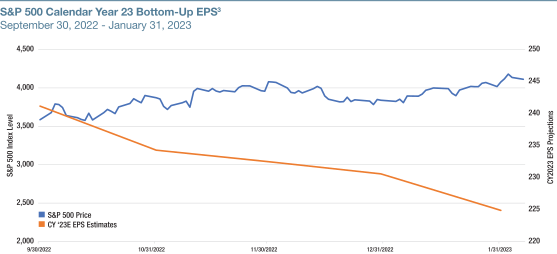
PAST PERFORMANCE IS NOT INDICATIVE OF FUTURE RESULTS. YOU CANNOT INVEST IN AN INDEX
Source: Factset (3)Bottom-Up Earnings Per Share (EPS) estimates for the S&P 500 represents the aggregate of consensus analyst estimates for each company within the index.
Solutions to Uncertainty: Investment Considerations and Opportunities for 2023
Following the heightened market volatility in 2022, a projected profits recession in the first half of 2023 hardly paints a rosy picture. However, crisis breeds opportunity, and investors with long-term time horizons and appropriate risk tolerances can take advantage of opportunities created by heightened market volatility. Here at Pacer ETFs, we advocate for investors to maintain a disciplined approach to investing in 2023. These are some of the key market trends we’re paying attention to in 2023, and potential solutions to the problems investors are facing.
Risk Mitigation:
For investors who are in or nearing retirement, market volatility can be daunting and potentially disrupt long-term financial plans. It’s important for clients to stay invested in order to reach their financial goals, but during extended market drawdowns many older and more conservative investors become primarily concerned with preventing further losses and “keeping the money they’ve earned”. Investors in the distribution phase (those who are drawing on their savings in retirement), face sequence of returns risk. Sequence of returns risk states that the order and timing of investment returns and withdrawals can have a big impact on how long retirement savings will last. The issue is exacerbated when clients take withdrawals during a market downturn, as they’re effectively “selling low” by drawing on a diminished pile of savings. The longer a market downturn persists and the steeper the max drawdown, the more difficult it becomes for investors to recoup their losses. Investors concerned with preserving capital should consider risk mitigation strategies, such as strategies with the ability to invest in low-volatility stocks, rules-based trend-following strategies, or buffered ETFs with defined levels of downside risk mitigation. These strategies have historically limited drawdowns during extended market selloffs.
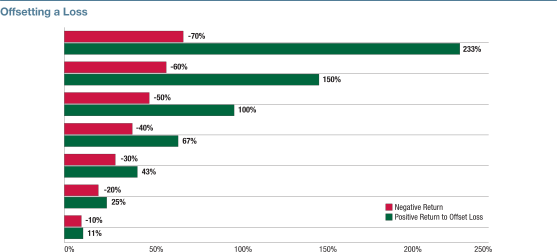
Source: Pacer Advisors
|
Related Pacer Funds: Pacer Trendpilot Series |
|
Related Pacer Funds: Pacer Swan SOS ETF Series |
Quality companies with high free cash flow
With analysts projecting a profits recession in the first half of 2023, it’s prudent for investors to consider quality companies with strong fundamentals. Investors may want to look to companies which have demonstrated an ability to grow earnings and companies with healthy balance sheets, as those companies are generally better positioned to weather a potential slowdown. Historically, companies with low debt levels and strong free cash flows may offer a greater margin of safety than companies which are burdened by debt or generate insufficient levels of cash from their core business to continue operating. Free cash flow (FCF) is the cash that remains after a company has paid all its expenses and reinvested in the business.
Companies with strong free cash flows are generally more self-sufficient than companies with lower or negative levels of FCF, and as such, they may be less likely to face situations which require them to take on additional debt, which has become particularly important over the past 12 months as interest rates and borrowing costs have risen rapidly. Additionally, during inflationary environments, investors tend to prefer assets which generate a high current cash return, so if inflation remains persistent in 2023, it’s possible investors will continue to seek companies with attractive free cash flows, as they did in 2022.
|
Related Pacer Funds: Pacer Cash Cows ETF Series |
Opportunities Outside Large Cap US Stocks
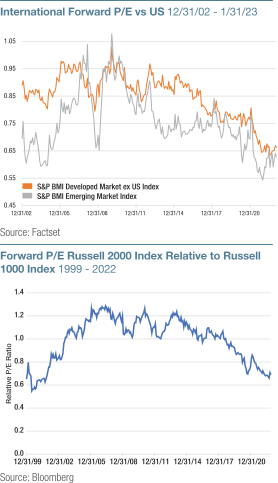
2022 was the worst year for Large Cap US stocks since 2008. This caused issues for many US investors, who in aggregate maintain a significant home country bias and are particularly overweight Large Cap (LC) US equities. Investors seeking to diversify their portfolios in 2023 may consider allocations to different geographies and market capitalizations, such as International or Small Cap equities. Over the past 10+ years, Small Caps and International equities substantially underperformed Large Cap US stocks. Despite this, many strategists are predicting a rotation from Large Cap US to Small Caps and International stocks in 2023. In addition to playing an important role in diversifying portfolios, International stocks currently offer attractive features such as substantial valuation discounts relative to LC US stocks (first chart), and many strategists believe International stocks could benefit from a weakening dollar 2023.
Small Caps also currently trade at substantial valuation discounts relative to LC US stocks (second chart), and have tended to outperform their LC peers during the early stages of a new market cycle. Many strategists are predicting a downturn in the first half of the year, followed by a recovery and the start of a new market cycle in the latter half of 2023. If that occurs, attractive valuations and historical precedent implies Small Caps may be well-positioned to take advantage of a recovery.
|
Related Pacer Funds: Pacer Cash Cows ETF Series |
Companies trading at reasonable valuations
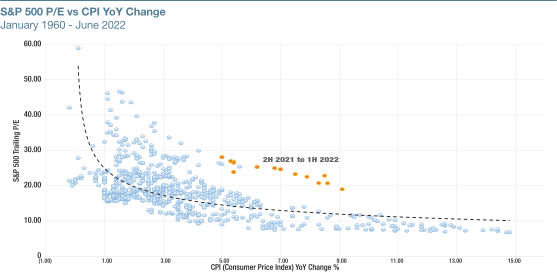
Historically low inflation and record low interest rates in the US, combined with accommodative central bank policies (such as Quantitative Easing QE) helped growth strategies experience some of their best returns ever over the past 10+ years. However, many of the macroeconomic variables which were supportive of higher valuations over the past decade reversed course in 2022. As we head into 2023, there are a few scenarios worth considering when thinking about what might happen to equity valuations, those are: unexpectedly high inflation, a potential profits recession, and changing investor risk tolerance. Historically speaking, inflation and equity market valuations have exhibited an inverse relationship.
If inflation persists in 2023, it’s possible market valuations could face continued downward pressure. In that scenario, companies trading at lower valuations could face less downward pressure than companies trading at elevated multiples whose cash flows are expected to come further in the future.
Source: fred.stlouisfed.org
If earnings decline as expected in the first half of the year, companies with higher expected growth rates (higher valuations) who fail to live up to lofty expectations may also face headwinds as investor risk appetites and expectations for future growth are revised lower. It’s prudent for investors to continue paying careful attention to the price they pay for the equities they own, and to be weary of stocks carrying lofty expectations (valuations).
Dividends; Domestic and Global
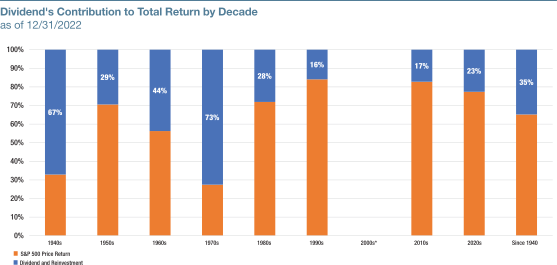
Fixed income had one of the worst years on record in 2022, leading many investors to re-evaluate the role it plays in their portfolios. On one hand, yields are now significantly higher along the entire curve than they were at the beginning of 2022, and as such, expected future returns are higher. On the other hand, traditional fixed-income’s failure to hedge against an equity market decline in 2022 has led many investors to question whether the fixed-income portion of their portfolio will provide the diversification they’d grown to expect. During the low interest rate regime which persisted from the end of the financial crisis through 2022, many investors were forced to seek the income they required from sources outside traditional fixed income, most notably equities. If investors are seeking yield outside traditional fixed income, it’s important to pay attention to where this yield is coming from. In the current environment, it’s prudent to avoid dividend traps by seeking out companies with strong FCF, as these companies are better positioned to maintain their dividends in the event of a slowdown. Strategies which provide higher levels of current income have also tended to perform well during inflationary environments and can help offset losses to principal in the event of a downturn.
Source: Morningstar. Dividends are not guaranteed. *2000s excluded because S&P 500 Total Return was negative for the decade.
|
Related Pacer Funds: Pacer Cash Cows ETF Series |
|
Related Pacer Funds: Pacer Custom ETF Series |
Factor and Sector Rotation Strategies
The steep declines experienced by traditional market-cap weighted indices in 2022 has many investors re-evaluating their low-cost passive “buy and hold” strategies.
At the same time, heightened market volatility has led to numerous changes in market leadership since the Covid-19 induced market bottom in March 2020. These rapid changes in market leadership create opportunities for dynamic strategies, which may be better suited to adapt to fast-moving markets than their traditional market-cap weighted counterparts.
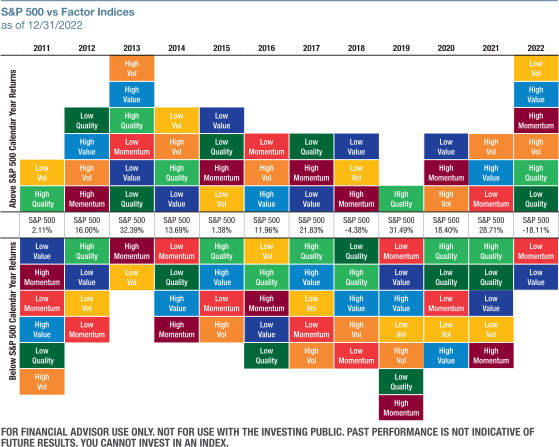
Academic literature uses historical data to support the claim that traditional factors outperform market-cap weighted benchmarks over the long-term. Unfortunately, these factors have a tendency to move in-and-out of favor in the short-term, leading many investors to abandon a factor-driven approach to investing altogether. At least one factor outperformed the S&P 500 in each of the 12 years from 2011-2022, and heightened market volatility in 2022 coincided with the greatest number of factors outperforming the S&P 500 in the past 10 years (since 2013). Strategies which use relative strength to rotate between factors may be able to avoid prolonged periods of underperformance stemming from a single factor, take advantage of changes in market leadership, and make it easier for investors to remain committed to factor investing strategies.
|
Related Pacer Funds: Pacer Factor ETF Series |
Growth strategies
2022 was the worst year for growth strategies since the financial crisis, which has many investors reconsidering their growth exposure heading into 2023. Other long-term investors view the selloff in growth stocks in 2022 as a potential buying opportunity. Low inflation and record low interest rates during the period from March 2009 through the end of 2021 led many investors to prefer growth companies with impressive top line sales growth, often at the expense of focusing on company profitability. As the macroeconomic landscape changed and investors began to seek out quality companies with strong fundamentals, unprofitable growth companies experienced sharp downturns in 2022.
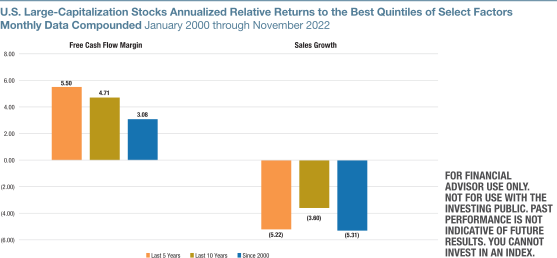
Whether investors are seeking to improve the growth portion of their portfolio or take advantage of the recent growth sell-off, it’s prudent for investors to consider growth companies with strong fundamentals and healthy FCF margins. Growth companies with higher FCF margins may be better equipped to weather an economic downturn, in the event one occurs in 2023. On the flip side, if economic growth rebounds in 2023, growth companies with above-average FCF margins may still be well positioned, since they’re able to use internally generated financing to fuel future growth. Investors seeking to use the selloff in growth stocks as a buying opportunity should consider companies with structural tailwinds. Companies which provide critical infrastructure for cutting-edge technologies are well positioned to capitalize on opportunities arising from rapidly growing sectors of the economy, such as e-commerce and the digital/data revolution. Finally, investors may want to consider growth strategies with the potential to limit downside risk, while also having the ability to generate attractive returns if economic growth surprises to the upside in 2023.
|
Related Pacer Funds: Pacer ETFs |
Key Takeaways:
In summary, from inflation to economic growth, from Fed policy to corporate earnings, the investing landscape is still full of uncertainties.
Although investing through uncertainty can be difficult, it’s imperative for investors to remain committed to a strategy which helps them achieve their long-term goals. Market volatility, while unnerving at times, may also present opportunities for skilled investors to generate excess returns. Investors seeking to limit portfolio drawdown may want to be proactive with their allocations entering 2023 by seeking out strategies with a demonstrated ability to preserve capital during extended selloffs.
While it’s impossible to know exactly what will transpire in 2023, it’s possible to position portfolios in such a way that gives investors a higher likelihood of achieving their long-term goals. Investors and advisors can do so by incorporating rules-based strategies into their portfolios
FOR FINANCIAL ADVISOR USE ONLY. NOT FOR USE WITH THE INVESTING PUBLIC.
Download